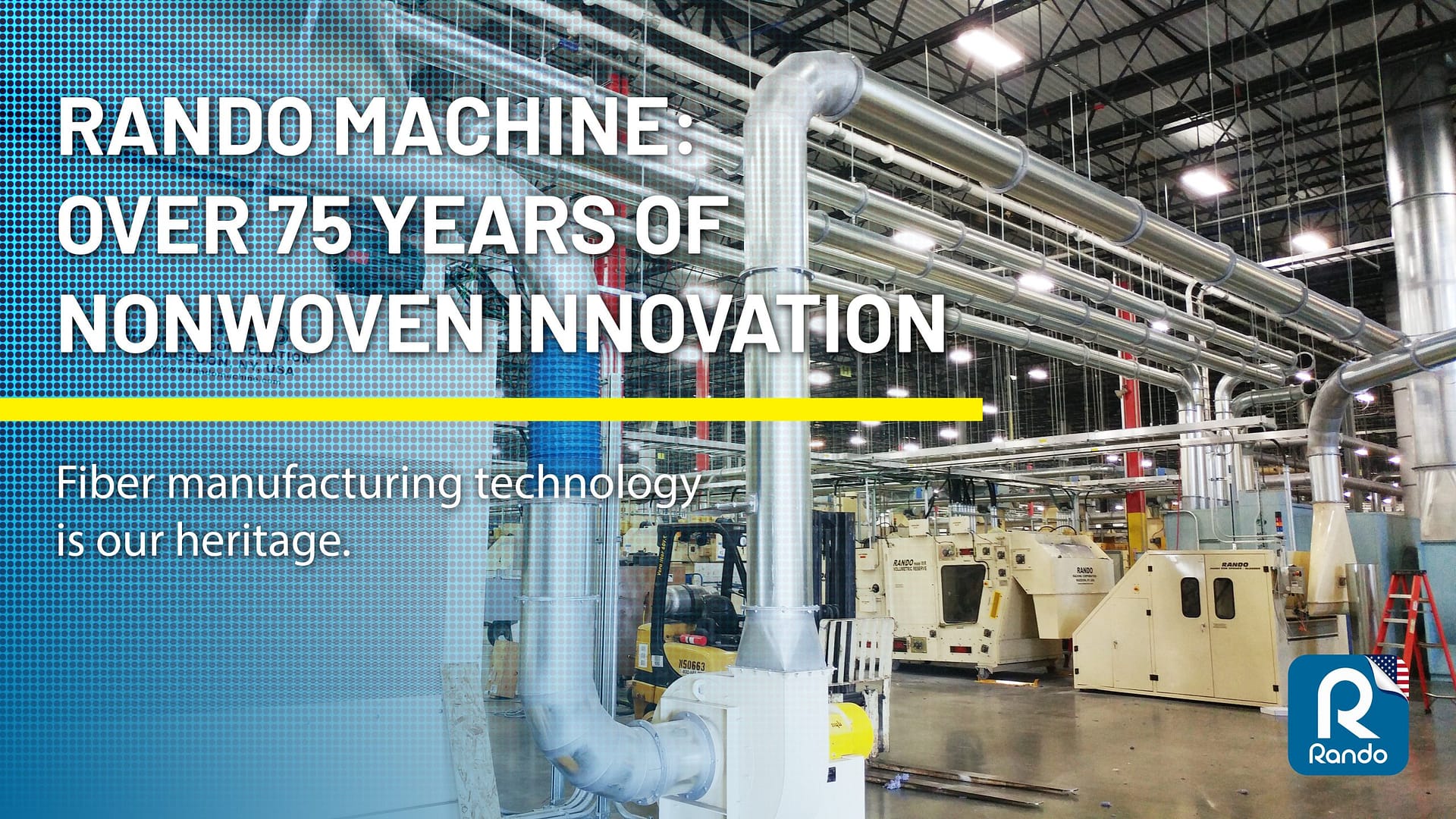
Globally recognized, Rando compliments its state-of-the-art web formation by adding fiber preparation equipment such as:
Bale Breakers
Volumetric Reserves
Pre-feeders
Opener/Blenders
This offers a more effective approach to fiber applications.
LABORATORY TESTING
Rando’s on-site Laboratory Testing Facility allows customers to:
Experience Rando’s air laid environment.
Test, experiment and innovate with various fibers, fiber blends and processes to improve current products and create new offerings.
Out-source and contract Rando’s test lab as a long term resource.
REPLACMENT PARTS / SERVICE
Rando keeps you up and running at peak performance with its highly technical replacement parts and services team.
Protect your performance with original replacement parts manufactured by Rando for every Rando machine, even vintage models. In addition, Rando offers reclothing/rewiring of wired rolls, using the original roll for your Rando rolls.
Rando’s highly trained technicians provide service globally, offering:
On-site performance evaluations
Installation of new machines
Repairs
Machine upgrades and retrofits
On-site maintenance
REPLACMENT PARTS / SERVICE
Rando is proud to announce the launch of its new product – the Rando™ Shredder Waste Reducer / Refiberizer; designed to refiberize and reclaim excess finished material produced from a nonwoven line. The Rando™ Shredder Waste Reducer / Refiberizer is outfitted with state-of-the-art technology to break down edge trimmings into small, uniform tufts that can then be reintroduced to production and blended to create a finished product.
Material transformation:
Material travels down a textured conveyor.
The edge trimmings are distributed into the feed rolls.
The feed rolls tightly pinch the fibers, and distribute them into the shredder’s main cylinder.
The main cylinder, equipped with more than 1,500 bear claws, shreds the fiber into uniform tufts, which are transported back into the production line by vacuum fans.
Customers report that excess material trimmed from the finished products take a heavy expense on their organizations — outside services are hired to remove and dispose of the excess material. A Rando™ Shredder Waste Reducer / Refiberizer eliminates this expense and refiberizes the excess fiber so it can be blended into their finished product.
Bottom Line: The Rando™ Reclaim Shredder provides an attractive option for manufacturers looking to save money and improve environmental practices, creating a more efficient and environmentally sound practice for the organization.
Every plant that makes bonded fiberglass or mineral fiber board produces waste it would rather not. There are many sources of bonded panel waste: Edge trim from squaring up panels, off-specification boards that missed a density or thickness target, startup and changeover scrap. For most manufacturers, that material is costly waste. When this material is easier landfilled than recycled, the fiber they already paid for and the cost of hauling it away is a quiet, expensive leak in an otherwise efficient operation.
Why bonded board is so hard to recycle
The waste piles up because the bonded board resists recycling with conventional recycling options. Once loose fiber has been bonded with resin or bonding fibers and pressed into a dense, rigid panel, it no longer resembles the original fiber feedstock at the start of the process. It is a tough, sometimes sticky, consolidated material. Breaking it back down into clean, usable fiber is a real mechanical challenge, and most equipment either cannot do it or destroys the fiber trying. To efficiently recycle these materials, often numerous steps are required, and most recycling machinery manufacturers lack the multi-step process to bring these fibers back to a usable state.
High-density fiberglass and mineral fiber insulations are among the most difficult of all to reclaim.
Refiberizing: turning the panel back into fiber
This is the job the Rando Shredder was built for. It takes bonded trim and off-spec material and breaks it back down into small, uniform tufts of fiber that can be fed back into the line and blended into new product. A bear-claw shredding roll and wire-wound feedrolls do the work, with anti-choking and anti-overfeed control so dense, difficult material moves through at a high rate without jamming. The result is not shredded scrap. It is reclaimed feedstock, uniform enough to reintroduce to production.
Downstream capabilities can be added on, depending on the fiber and finished product feedstock. The Rando Refiberizer can follow the Rando Shredder, furthering the process of fiber being brought back to a usable state. Pneumatic air separation can remove dust and debris from the air stream, further cleaning the fiber. There are many configurations that can be explored to repurpose your bonded panel waste, and every assembly of technologies is as unique as the feedstock.
Waste into profit, and a step toward zero waste
The economics are straightforward. Every pound of panel reclaimed is a pound of fiber you do not have to buy again, and a pound you do not have to pay to landfill. A waste stream becomes a feedstock stream. For manufacturers chasing zero-waste goals, it closes one of the hardest loops on the floor, the dense bonded scrap that usually has nowhere to go. The reclaim system earns its keep twice, once on raw material and once on disposal.
Built around your material, not the other way around
No two recycling problems are identical. Fiberglass behaves differently from mineral fiber. A high-density board recycles differently from a light one. One plant wants reclaimed fiber fed straight back into a single line, another needs it metered across several. That is why Rando engineers the system to the feedstock rather than forcing the feedstock to the machine. The shredder comes in 36 and 60 inch widths and in custom sizes, and it pairs with the rest of Rando’s machinery range, like volumetric reserves, weigh conveyors, and openers, and more, so reclaimed fiber can be stored, metered, and reintroduced exactly the way a given product needs.
Bonded fiberglass and mineral fiber waste has long been one of the hardest things in the plant to deal with, which is exactly why it is worth solving. Rando has spent its history turning difficult fiber into useful nonwoven materials. Reclaiming bonded panels follows Rando’s legacy of solving difficult challenges with engineering and reliable manufacturing equipment. With Rando, turn waste into profit and explore our bonded panel recovery solutions.
Let’s discuss bonded panel recycling
We’d love to hear about your bonded panel recycling challenges.
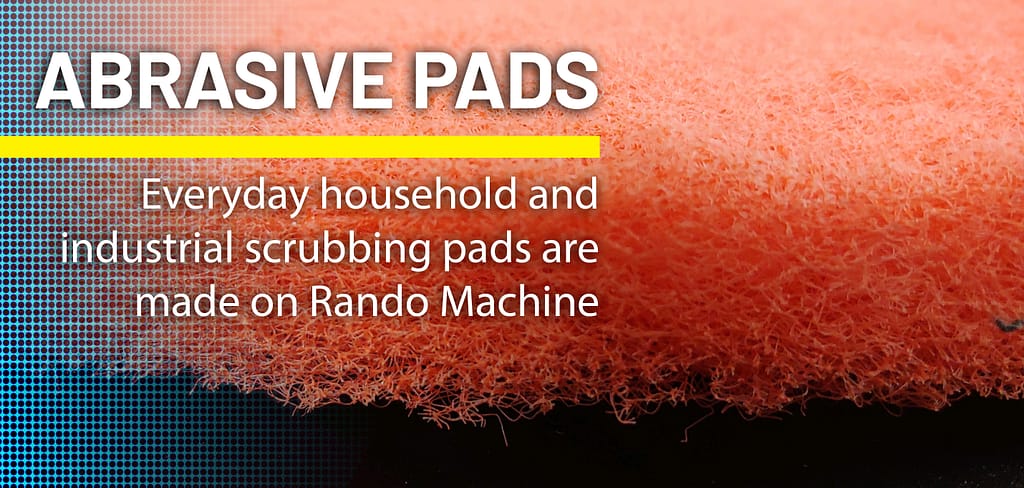
Look under your kitchen sink. There is a good chance you will find a scrubbing pad, the kind you reach for to clean stubborn pan. Walk through a grocery store after hours and you will see a floor buffer gliding across the tile on a thick round pad. Open a toolbox and you will probably find a gray finishing pad for smoothing metal or wood. These products have almost nothing in common, except one thing: each began as individualized fibers formed into a web. There is a strong chance the machine that made that everyday material was built by Rando.
What a nonwoven abrasive actually is
An abrasive pad is not woven like cloth. It is a nonwoven, a three-dimensional web of fiber with open air space running all through it, coated with abrasive grit and bonded to hold its shape. That open, airy structure is by design. The web of fibers with airspace is what holds the grit, controls how aggressively the pad buffs, and decides how evenly it wears. With the right web formation, the pad performs for its intended application.
Why air-laid forming wins in abrasive pads
This is exactly where Rando’s technology earns its reputation. Rando’s air-laid web forming lays fiber in true random orientation, so the web is uniform and open in every direction, what engineers call an isotropic structure. For an abrasive pad, that uniformity is everything. It spreads the grit evenly, gives a consistent contact across the whole surface, and produces the uniform contact across the width of the material. The consistency enabled by Rando airlay forming, like with the Rando Webber, is a big part of why Rando is recognized worldwide as a leading choice for commercial floor scrubber and buffer pads.
One technology, from the gentle pad to the heavy one
The Rando Webber is able to achieve a significant range of basis weights with a variety of abrasive fiber types. This makes the Rando Webber very versatile for abrasive pad manufacturers. The same air-laid technology makes a delicate hand pad and a heavy industrial floor pad, with web weights running from 25 grams per square meter can make abrasive pads all the way past 2,500 grams per square meter. With the range of basis weights also comes the ability to handle fibers from 3 to 200 denier, fine to super coarse. That span is why the soft pad you use on a nonstick pan and the aggressive pad that strips a warehouse floor can both come off Rando machinery.
The hard end of the range
The heavy end of densities and fiber deniers is where it manufacturing abrasive pads with traditional nonwoven machinery becomes difficult, if not impossible. The most demanding abrasive pads run stainless steel and other tough, wiry fibers that chew up equipment built for soft synthetics. For instance, the fiber opening and preparation technologies Rando has in its portfolio can be modified for stainless steel and similar fibers. Few machines can form a clean, uniform web from stainless steel fiber. Rando has done it for decades, and is core to why Rando has a presence across 6 continents.
Ordinary places, uncommon machinery
Rando abrasive webs end up in a lot of ordinary places: the scrub pads in the kitchen, the buffer pads under commercial floor machines, the finishing pads in workshops and factories. Millions of these products move through homes and businesses every year, formed on machines almost no one outside the industry has heard of.
That is the quiet story of Rando. For 75 years it has built the machines behind products people use every day without a second thought. An abrasive pad does not come with a label explaining how its web was formed. But the next time one makes quick work of a burnt pan with a scrubbing sponge, you can think to the start of this products life on a Rando machine.
Abrasive Manufacturers: Trial Rando Equipment on our Pilot Line
See how Rando’s abrasive web systems work, bring your fiber to the pilot line and form it for yourself.
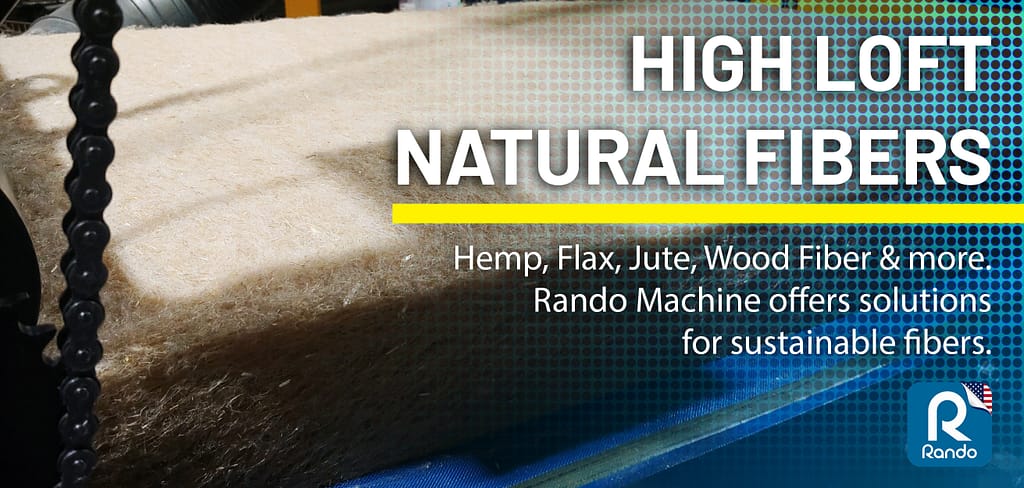
Natural fibers are having a moment. Fibers such as Industrial hemp, flax, jute, and kenaf are moving from niche to mainstream as manufacturers look for renewable, low carbon, biodegradable alternatives to glass fiber and petroleum-based materials. The demand is growing across biocomposites, agriculture, and building insulation. The catch is that natural fibers are difficult to process: they are mixed denier, length, and dusty. Most nonwoven web forming and fiber opening and blending equipment was never built for them. Rando technology excels with natural fibers, from fiber preparation to web forming.
Why natural fibers defeat ordinary equipment
Bast fibers like hemp, flax, jute, and kenaf are nothing like the clean, uniform synthetic staple most machines are tuned for. They often arrive bale with variable inconsistent lengths, with coarse and fine fractions mixed together, plus dust and shive. They change from batch to batch, and even within a single bale. This inconsistency can be the virtue of a natural material subject to weather, growing conditions, soil quality, etc. The standard fiber machinery Equipment on the market designed for fiber with regularity like polyester chokes on that variability. Rando’s entire history is running the fibers other machines struggle with, which makes natural fiber a production fit with Rando Machinery.
From baled fiber to a uniform web
Processing natural fiber well starts before the Rando web former, or before any airlay for that matter. Rando’s openers, blenders, and bale breakers take compressed, tangled bales and open them into a consistent, free-flowing fiber stream, mixing coarse and fine fractions and metering the material evenly. Depending on your goals, Rando can size fiber opening equipment to be as aggressive as needed for fiber preparation. That preparation is the difference between a lumpy, inconsistent web and a web with high uniformity.
From there, the Rando Webber lays the fiber in true random orientation, producing a uniform web with even weight and loft across the working width. Again here, Rando can size working widths to your specific needs. For instance, natural fiber construction materials may require 4ft or 8ft increments, where geotextile materials may require 10ft to 12ft increments. Natural fibers are often blended with a binder or bicomponent fiber for thermal bonding, so the Webber’s ability to combine dissimilar fibers into one consistent web matters. And the high-loft condenser forms webs from thin mats up to ten inches tall, which opens the full range of natural fiber products, from dense composite mats to lofted insulation batts.
Three markets, one platform
Biocomposites: Natural fiber mats are replacing glass fiber in automotive interior panels and construction composites, offering lower weight, renewable content, and strong mechanical performance. A uniform, isotropic web gives the consistent fiber distribution a good composite depends on.
Agricultural growing media: Natural fiber substrates are emerging as a renewable, biodegradable alternative to rockwool and peat for hydroponics, propagation, and controlled-environment agriculture. Here loft and uniformity govern water retention and root aeration, which are exactly the web properties the Webber is built to control.
Insulation: Natural fiber batt insulation is one of the fastest-growing sustainable building materials, valued for renewable content, carbon storage, and healthier indoor air. Lofted, thermally bonded natural fiber webs are the core of the product, and high-loft air-laid forming is how they are made.
These three examples are just the tip of the iceberg. Innovation in natural fibers and natural fiber nonwovens are creating new and exciting markets for natural fiber materials. Rando can support you in developing your product concept on our trial line.
Renewable by nature, proven on the line
Natural fiber processing sits comfortably with Rando’s oldest instinct. The company was founded reclaiming waste cotton, and renewable and recycled fiber has been in its DNA ever since. Natural fibers extend that story: crops that store carbon as they grow, processed into products that can biodegrade at the end of their life.
Because natural fiber varies so much, proving a process before committing to a line matters more here than almost anywhere. Rando’s pilot line lets a manufacturer run their actual material, whether it is hemp from one region or jute from another, and see the web before buying the machine that makes it.
The natural fiber market is growing because the world wants renewable materials. Rando has spent 75 years building the machines that turn difficult, variable fiber into a uniform, useful web. From hemp to jute, that is exactly the kind of problem worth solving.
Try your natural fibers
See how Rando’s lineup handles natural fiber, or bring your hemp, flax, or jute to the pilot line and watch it form.
There is no more demanding test of materials than in the far reaches of our atmosphere and beyond. NASA has long explored the materials and methods of making materials that can help achieve space research objectives. Today, Rando is a key partner in engineering and manufacturing nonwoven materials for the demands of atmospheric entry. Why are the materials used in spacecraft development so important, and how is Rando turning fibers into materials to solve the most rigorous challenges?
A spacecraft hitting the top of an atmosphere at tens of thousands of miles per hour turns its leading surface into a wall of heat, hot enough to vaporize most materials. Polyesters, nylons, and conventional fibers are not suited for the job. Nonwoven heatshields with advanced fibers, however, are suited for the development of spacecraft thermal protection systems. Thanks to Rando’s airlaid technology, a new material is being explored to build the next generation of those heatshields.
The heatshield problem NASA is solving
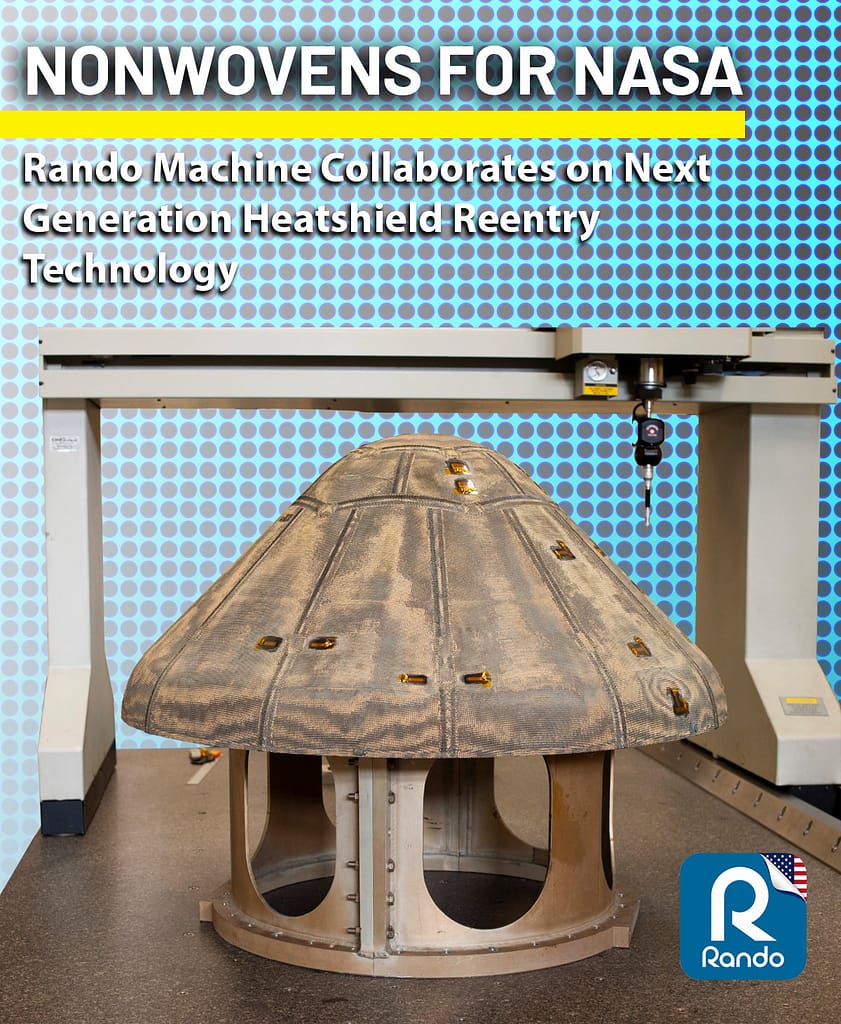
NASA’s Heatshield for Extreme Entry Environment Technology program, known as HEEET, was created to protect probes entering the most punishing atmospheres in the solar system, beginning with Saturn and Venus. Its core is a dual-layer, three-dimensional woven material: a dense carbon-fiber layer that faces the heat, over a lower-density insulating layer that keeps it from reaching the vehicle. The system is engineered to survive peak heat flux well beyond 1,500 watts per square centimeter, and NASA has documented that it can do so at more than 40 percent less mass than conventional carbon phenolic it replaces. The woven material is produced by Bally Ribbon Mills. Woven materials have timetested performance, but often involve higher costs than nonwoven materials.
Where air-laid web forming enters the picture
Making that insulating layer thicker, more cost effective, and faster to produce, is an active area of NASA research, now aimed at scaling the material for Mars, low Earth orbit, and other planetary entry. In a 2024 NASA Phase II SBIR award, a team of companies from the textile, nonwoven, and space exploration industries are developing an Additive Insulation Layer for HEEET: a nonwoven web, made from the insulation layer yarn. The nonwoven layer is then needle punched onto the woven insulation to build up thickness while preserving the low fiber volume the insulation depends on.
In this sense, a Rando manufactured nonwoven technology works synergistically with a woven material. This early-stage development places Rando’s core technology and capabilities inside one of the most extreme material challenges there is.
Why air-laid is a natural fit for the job
The reason Rando’s Airlaid technology is a fit for this extreme application is the same reason Rando’s webs perform in industries like thermal insulation on Earth: randomized fiber webs laid with a consistent and isotropically formed structure trap air and resist heat and thermal flux. For a thermal insulation layer used in space, that uniformity matters, because heat finds inconsistency. Forming a controlled, low-density web from short, chopped, and difficult yarn is precisely the capability Rando has spent 75 years refining on industrial fiber.
From waste fiber to the edge of space
The same random airlaid technology principle developed in 1949 that solved the problems of low value waste fiber recycling is now being explored to help protect a spacecraft entering another planet’s atmosphere. Rando’s greatest strength when it comes to its’ Rando Webber for airlay applications is its ability to handle virtually any fiber, and lay that fiber randomly and uniformly. We’re proud to created engineered solutions for demanding applications both on earth and beyond.
Explore our Capabilities
See how Rando’s air-laid web forming handles demanding fiber, or bring your material to the pilot line.
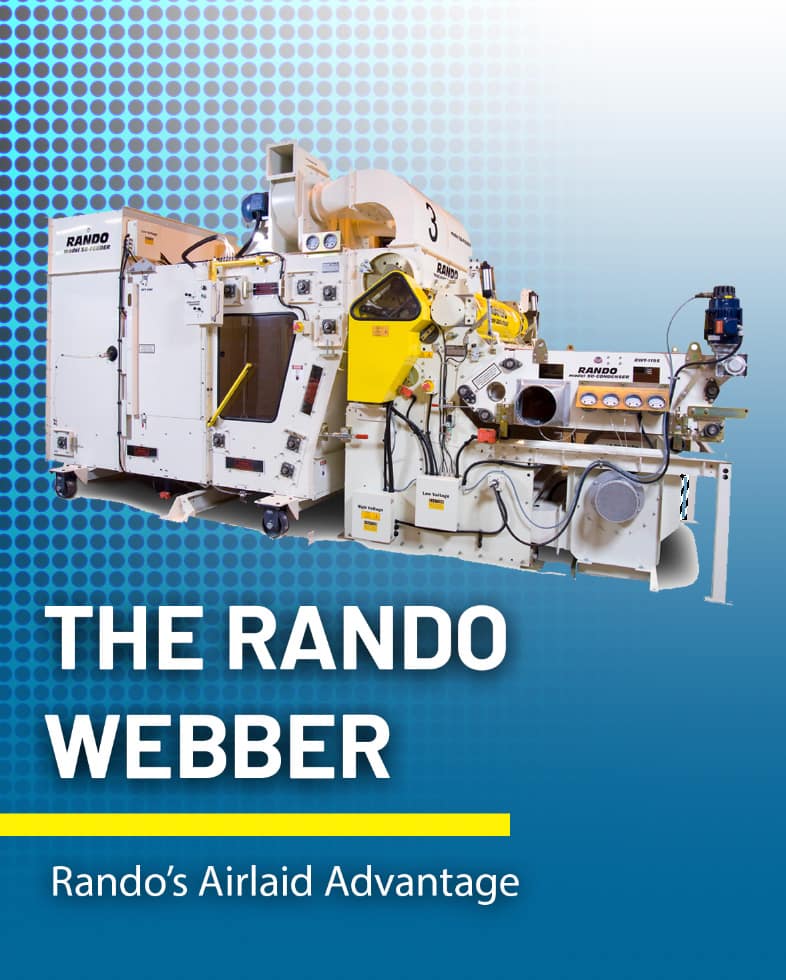
Every company has one machine that defines it. For Rando, it is the Webber. This machine is the airlaid web former that gave the company its name, and three quarters of a century later it is still the reason customers bring Rando their hardest fibers. The Webber does one thing exceptionally well: It lays loose fiber into a uniform web with true random orientation, and it does it with materials most equipment cannot touch.
Why random fiber orientation excels
There are many options for fiber web forming on the market. Many often look to carding machines for forming webs, and while carding certainly has its applications, it also has it’s limitations. Carding combs the fibers until they line up in the machine direction, which makes a web that is generally strong one way and weak the other. The Rando Webber does the opposite. It distributes fiber randomly and evenly in every direction, so the web has isotropic strength, meaning equal strength in all directions. That randomized uniformity the intention of the Rando Webber, and it is where the company got its name.
For a buyer, isotropic strength shows up as real performance: consistent weight, consistent loft, and uniform quality across the full width of the web. A web that behaves the same in every direction is easier to convert, more predictable in the field, and better suited to demanding applications from composites to filtration and everything in between.
One mechanism, built for control
The Webber forms the web with air, using a split air system that works the fiber with both pressure and vacuum, paired with AC variable-speed motors that give the operator fine control over how the fiber lands. That control is what produces the uniformity, and it is what lets a single platform run an unusually wide range of material and web geometry. Webs come off the machine anywhere from 12 to 110 inches wide, from thin veils to thick high-loft batts.
The Webber is also built on Rando’s wide options of configurations, it is not limited to a single configuration. It comes in three condenser styles, so the same platform can be tuned to the fiber and the web you actually need.
The SB condenser is built for heavier fibers, roughly 25 to 100 denier and above, forming at up to 66 feet per minute. The SD condenser handles the fine end, from nano fibers up to 100 denier, and runs fast, up to 150 feet per minute. The SHL condenser adds high loft to everything the SD can do, forming webs from three quarters of an inch to a full 10 inches tall.
What makes the SHL remarkable is the control. An operator moves loft across that entire range by adjusting speeds on the HMI, with no mechanical changeover. Many competitors lack the condenser optionality, and this optionality adds revenue generating potential for our customers. It runs fiberglass, synthetics, and natural fibers like hemp, jute, wood, and cotton with equal ease. That span, from a nano-denier veil to a 10-inch batt, is why one Webber platform can serve markets that would otherwise need several different machines.
The fibers other machines refuse
The Webber’s real signature is what it will run. Rigid and specialty technical fibers, glass, carbon, ceramic, and metallic fibers cause significant complications on equipment built for polyester. Thanks to Rando’s supporting fiber opening machinery, the Rando Webber can bring in low-melt fibers like polyester or polyethylene bicomponents, blends of dissimilar lengths and deniers, and recycled and regenerated waste.
Since 1949, Rando has taken pride in its ability to produce machinery that serves multiple industries. The same machine that runs stainless steel fiber for abrasive pads runs recycled shoddy for sustainable insulation, and even fiberglass edge trim reclaimed from a Rando’s bonded panel recycling machinery. With one forming platform, an enormous range of fibers are possible.
From the lab to the production floor
Rando builds its Rando Webber from pilot width up to wide commercial lines available in multi-meter width formats. With a visit to our trial facility in Victor, New York, a customer can prove a process on Rando’s pilot line and then buy the production version of the very machine they tested. The webs it forms end up in automotive components, filtration media, geotextiles, medical disposables, insulation, and more.
Since 1949, the Rando Webber has been our centerpiece machine for the fibers our competitors struggle with.
Book a trial on our Pilot Line today to see the Rando Webber in Action
As the cotton industry boomed across the American South, the industry had a problem it could not throw away. Its cotton mills and associated industries were producing waste fiber by the ton: short, tangled, uneven, and useless to the machinery of the day. In 1949, Rando was founded to solve exactly that. The idea was simple: take the fiber nobody wanted, and turn it into something with value.
To do it, Rando helped pioneer random air-laid nonwoven forming, a method of using custom technology to form fibrous webs. This was Rando’s solution to utilizing a sub-grade cotton fiber, a messy input with limited value. This origin story, dating back to 1949, has opened the lane the company has occupied ever since. Today, Rando’s capabilities far exceed just random airlaid technology. The company has since pioneered methods to handle the toughest fiber challenges. From fiber blending, opening, bonded panel recycling, and more, Rando has found a niche as both a global pioneer of nonwoven fiber manufacturing technologies, while also being the only company in the United States to manufacture nonwoven solutions to this day.
From a workshop idea to a machinery company
Following the invention of unique air-laid forming technology in the 50’s and 60’s from a small workshop, Rando has grown into a company with a global portfolio of installations. The following decades broadened Rando’s narrow expertise of waste cotton fiber into a company capable of producing full lines of machinery. In 1974, Rando was formally incorporated as Rando Machine Corporation in Macedon, NY. What began as a way to reclaim waste cotton grew into fiber preparation, web forming, and recycling equipment, sold to manufacturers who needed custom built solutions for their most difficult challenges.
The thesis of Rando has stayed true: Rando’s reputation was built on applications that were too demanding, too specialized, or too unusual for standard equipment. That is still where the company wins today in 2026.
Why the old advantage is still the advantage
Rando’s core forming technology uses pressure and vacuum together to lay the web of fibers. The result is an isotropic structure, meaning the fibers are oriented randomly and evenly in every direction, rather than pulled into a grain, as is seen with carding technology. This randomized uniformity resulting from this technology even resulted in the namesake of the business, Rando Machine. It shows up as measurable performance in insulation and filtration, and it is difficult for competitors to replicate. It is the reason Rando is recognized worldwide as the best choice for commercial floor scrubber pads, and for most applications that run on stainless steel fiber.
Stainless steel fiber is a good illustration of the whole philosophy of Rando Machines. It is stiff, heavy, and abrasive, the kind of material that defeats equipment built for polyester. Rando has won global contracts for stainless steel abrasive nonwoven pads, and today it is recognized as the global leader for abrasive nonwovens. The same is true for short and difficult to process fibers, like carbon and aramid. These challenging fibers are a natural fit for Rando Machines. Today, with global textile waste requiring innovative solutions to solve recycling challenges, recycled and regenerated shoddy fibers containing cotton, polyesters, lyocell, and more also find a natural fit in Rando’s nonwoven manufacturing portfolio.
What Rando is today
Three quarters of a century in, Rando designs and builds fiber preparation, web forming, and recycling equipment in New York, with machines running on six continents. The company found its next evolution in 2019, when Andy Wilcox, the owner of EIS and Inline Cleaning Solutions, acquired Rando Machine. With EIS and Inline Cleaning Solutions already possessing industrial machining technologies in its manufacturing center in Indiana, Rando has found ways to leverage production cost savings by extending its footprint beyond its New York State manufacturing hub. In a globally competitive environment for nonwoven OEM technology, Rando today is able to produce price competitive machines produced entirely in the United States.
Following the acquisition of Rando by Wilcox, substantial investments were made into Rando’s trial line. Wilcox, working with Rando’s brilliant engineering mind Bill Hardy, understood the importance of customers needing to build confidence in the technology through laboratory testing. From its workshop in Victor, New York, new and existing customers can prove out a process before they buy it. This trial line is one of the few places in North America to trial staple-fiber airlay at production scale. Rando’s trial line has processed cotton, textile shoddy, difficult natural fibers like hemp, flax, jute, and more. With an engineering-first mindset, Rando understands the importance of continued service and after-sales parts. Rando has a team of parts and field service technicians, able to work globally with their customers to ensure downtime is minimized and that production output is maximized.
Sustainability from day one
The nonwoven and textile industry talks about the importance of fiber recycling and utilization as if it were new. For Rando it is the founding purpose. The company was born reclaiming waste cotton, and it has been building recycling machinery ever since. Today that means fiberglass edge trim recovery, bonded panel reclamation, and the recycled and regenerated fibers that started it all. The sustainability story writes itself: it’s the how and why of Rando’s founding.
Seventy-five years is a long time to keep solving the same problem, but the technology and the solutions have not stayed the same. Rando Machines portfolio of technology today handles fibers that weren’t part of the conversation in 1949. While Rando’s competition focuses on cost reduction and winning the easy categories, Rando stays ahead by focusing on the demanding applications, the difficult fibers, and the jobs that call for a true engineering partner. Since 1949, that is what Rando has built.
Explore what Rando’s machinery can do with your fiber, or bring your material to the pilot line and see Rando’s capabilities for yourself.