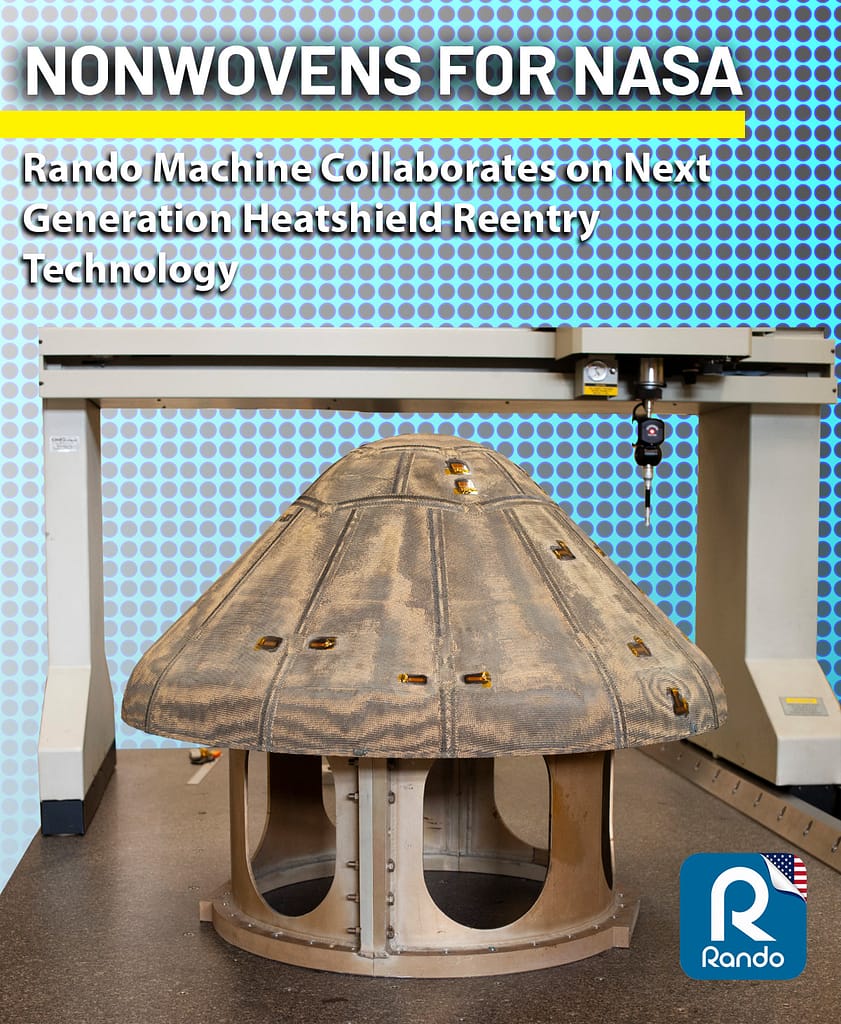
There is no more demanding test of materials than in the far reaches of our atmosphere and beyond. NASA has long explored the materials and methods of making materials that can help achieve space research objectives. Today, Rando is a key partner in engineering and manufacturing nonwoven materials for the demands of atmospheric entry. Why are the materials used in spacecraft development so important, and how is Rando turning fibers into materials to solve the most rigorous challenges?
A spacecraft hitting the top of an atmosphere at tens of thousands of miles per hour turns its leading surface into a wall of heat, hot enough to vaporize most materials. Polyesters, nylons, and conventional fibers are not suited for the job. Nonwoven heatshields with advanced fibers, however, are suited for the development of spacecraft thermal protection systems. Thanks to Rando’s airlaid technology, a new material is being explored to build the next generation of those heatshields.
The heatshield problem NASA is solving
NASA’s Heatshield for Extreme Entry Environment Technology program, known as HEEET, was created to protect probes entering the most punishing atmospheres in the solar system, beginning with Saturn and Venus. Its core is a dual-layer, three-dimensional woven material: a dense carbon-fiber layer that faces the heat, over a lower-density insulating layer that keeps it from reaching the vehicle. The system is engineered to survive peak heat flux well beyond 1,500 watts per square centimeter, and NASA has documented that it can do so at more than 40 percent less mass than conventional carbon phenolic it replaces. The woven material is produced by Bally Ribbon Mills. Woven materials have timetested performance, but often involve higher costs than nonwoven materials.
Where air-laid web forming enters the picture
Making that insulating layer thicker, more cost effective, and faster to produce, is an active area of NASA research, now aimed at scaling the material for Mars, low Earth orbit, and other planetary entry. In a 2024 NASA Phase II SBIR award, a team of companies from the textile, nonwoven, and space exploration industries are developing an Additive Insulation Layer for HEEET: a nonwoven web, made from the insulation layer yarn. The nonwoven layer is then needle punched onto the woven insulation to build up thickness while preserving the low fiber volume the insulation depends on.
In this sense, a Rando manufactured nonwoven technology works synergistically with a woven material. This early-stage development places Rando’s core technology and capabilities inside one of the most extreme material challenges there is.
Why air-laid is a natural fit for the job
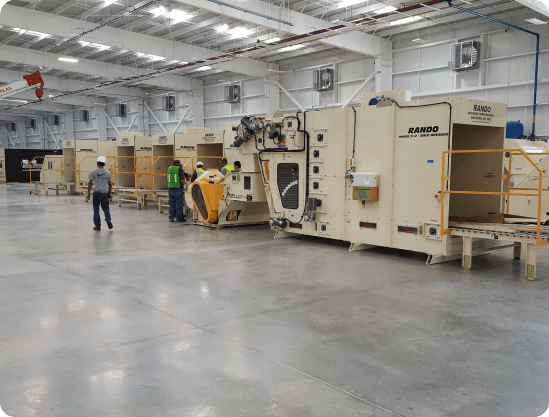
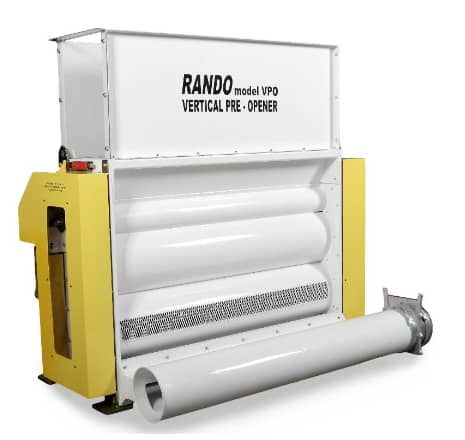
The reason Rando’s Airlaid technology is a fit for this extreme application is the same reason Rando’s webs perform in industries like thermal insulation on Earth: randomized fiber webs laid with a consistent and isotropically formed structure trap air and resist heat and thermal flux. For a thermal insulation layer used in space, that uniformity matters, because heat finds inconsistency. Forming a controlled, low-density web from short, chopped, and difficult yarn is precisely the capability Rando has spent 75 years refining on industrial fiber.
From waste fiber to the edge of space
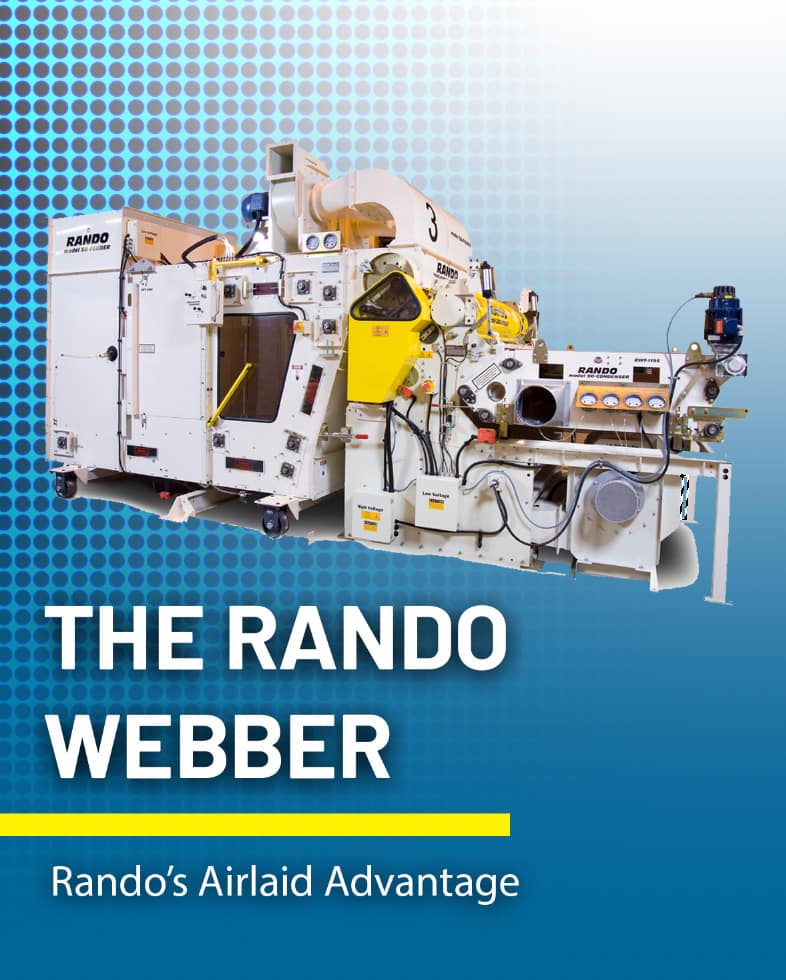
The same random airlaid technology principle developed in 1949 that solved the problems of low value waste fiber recycling is now being explored to help protect a spacecraft entering another planet’s atmosphere. Rando’s greatest strength when it comes to its’ Rando Webber for airlay applications is its ability to handle virtually any fiber, and lay that fiber randomly and uniformly. We’re proud to created engineered solutions for demanding applications both on earth and beyond.
Explore our Capabilities
See how Rando’s air-laid web forming handles demanding fiber, or bring your material to the pilot line.