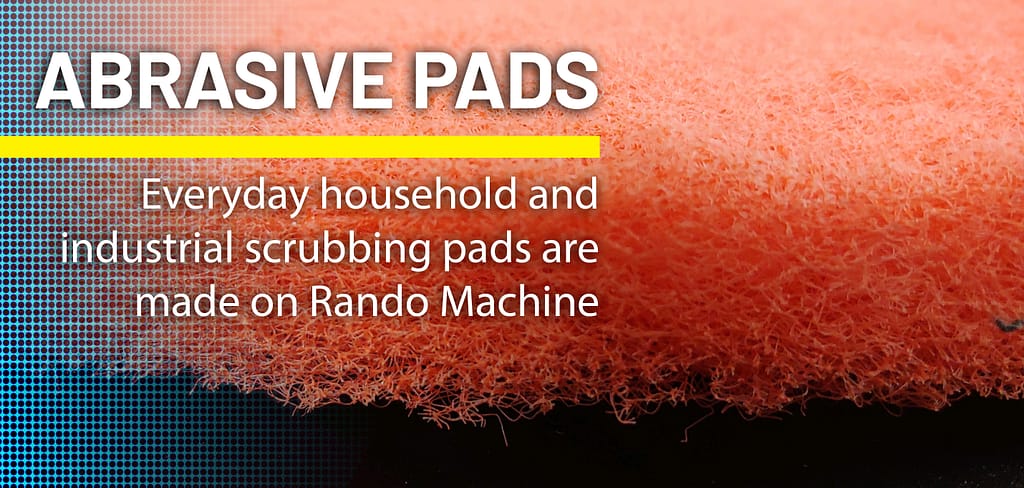
Look under your kitchen sink. There is a good chance you will find a scrubbing pad, the kind you reach for to clean stubborn pan. Walk through a grocery store after hours and you will see a floor buffer gliding across the tile on a thick round pad. Open a toolbox and you will probably find a gray finishing pad for smoothing metal or wood. These products have almost nothing in common, except one thing: each began as individualized fibers formed into a web. There is a strong chance the machine that made that everyday material was built by Rando.
What a nonwoven abrasive actually is
An abrasive pad is not woven like cloth. It is a nonwoven, a three-dimensional web of fiber with open air space running all through it, coated with abrasive grit and bonded to hold its shape. That open, airy structure is by design. The web of fibers with airspace is what holds the grit, controls how aggressively the pad buffs, and decides how evenly it wears. With the right web formation, the pad performs for its intended application.
Why air-laid forming wins in abrasive pads
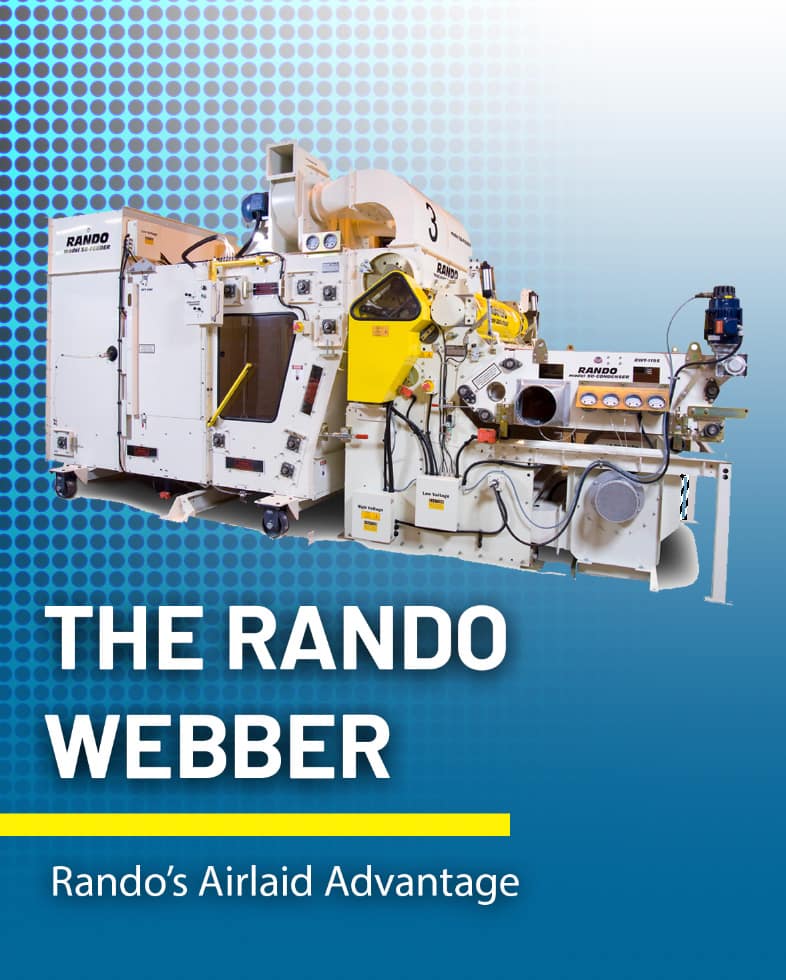
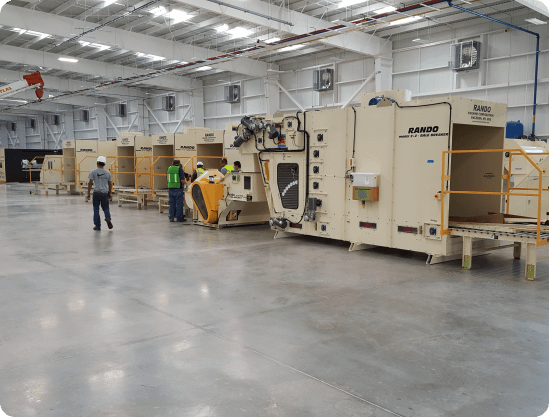
This is exactly where Rando’s technology earns its reputation. Rando’s air-laid web forming lays fiber in true random orientation, so the web is uniform and open in every direction, what engineers call an isotropic structure. For an abrasive pad, that uniformity is everything. It spreads the grit evenly, gives a consistent contact across the whole surface, and produces the uniform contact across the width of the material. The consistency enabled by Rando airlay forming, like with the Rando Webber, is a big part of why Rando is recognized worldwide as a leading choice for commercial floor scrubber and buffer pads.
One technology, from the gentle pad to the heavy one
The Rando Webber is able to achieve a significant range of basis weights with a variety of abrasive fiber types. This makes the Rando Webber very versatile for abrasive pad manufacturers. The same air-laid technology makes a delicate hand pad and a heavy industrial floor pad, with web weights running from 25 grams per square meter can make abrasive pads all the way past 2,500 grams per square meter. With the range of basis weights also comes the ability to handle fibers from 3 to 200 denier, fine to super coarse. That span is why the soft pad you use on a nonstick pan and the aggressive pad that strips a warehouse floor can both come off Rando machinery.
The hard end of the range
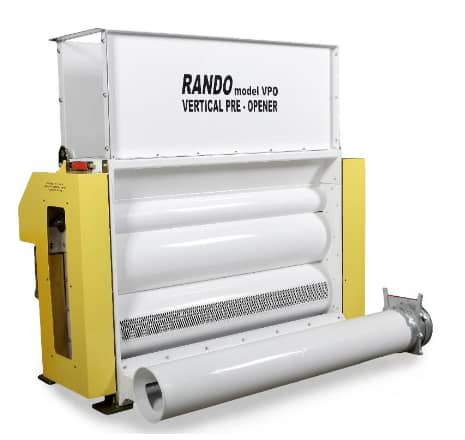
The heavy end of densities and fiber deniers is where it manufacturing abrasive pads with traditional nonwoven machinery becomes difficult, if not impossible. The most demanding abrasive pads run stainless steel and other tough, wiry fibers that chew up equipment built for soft synthetics. For instance, the fiber opening and preparation technologies Rando has in its portfolio can be modified for stainless steel and similar fibers. Few machines can form a clean, uniform web from stainless steel fiber. Rando has done it for decades, and is core to why Rando has a presence across 6 continents.
Ordinary places, uncommon machinery
Rando abrasive webs end up in a lot of ordinary places: the scrub pads in the kitchen, the buffer pads under commercial floor machines, the finishing pads in workshops and factories. Millions of these products move through homes and businesses every year, formed on machines almost no one outside the industry has heard of.
That is the quiet story of Rando. For 75 years it has built the machines behind products people use every day without a second thought. An abrasive pad does not come with a label explaining how its web was formed. But the next time one makes quick work of a burnt pan with a scrubbing sponge, you can think to the start of this products life on a Rando machine.
Abrasive Manufacturers: Trial Rando Equipment on our Pilot Line
See how Rando’s abrasive web systems work, bring your fiber to the pilot line and form it for yourself.