preloader-matrix

Machines

News

Filter by:

Fiber Recycling: What It Is, How It Works & Why It Matters in 2026

Introduction

Fiber Recycling - RandoMachine

What Is Fiber Recycling?

Nonwoven fiber recycling is the process of taking waste or scrap materials and breaking them down into usable fiber that can be used to manufacture new products.  Fibers can be recovered during the manufacturing process (before or after bonding), as well as recycling used materials such as textiles.  Some examples include:

  • reusing edge-trim in the manufacturing process
  • Re-fiberizing skeletons or scrap bonded material to recover and reuse the fiber
  • Shredding and re-fiberizing textile waste
  • Blending recycled fibers into virgin material streams to manufacture new products
  • Using chemical processes to break down textile waste into component fibers which can then be used to manufacture new products
  • Using mechanical processes such as shredding and re-fiberizing to create fibers which can be blended with virgin fiber to create new products

Types of Fiber Recycling

Fiber recycling is commonly divided into two main categories based on how materials are processed.

1. Mechanical Fiber Recycling

  • Shredding tears materials into small pieces which can be re-fiberized in an opener or card machine
  • Opening or re-fiberizing pulls shredded materials apart using wired rolls so the output can be used to manufacture new products
  • Quality loss factors include fiber length and color consistency. Many fibers can be mechanically recycled with quality similar or even surpassing virgin fiber.  Mechanical recycling can shorten fiber length for certain fibers such as cotton, which necessitate blending a percentage of virgin fiber with recycled fibers to maintain strength

2. Chemical Fiber Recycling

Chemical fiber recycling uses chemical processes to break down fibrous materials into molecular building blocks, which can then be used to create new high quality fibers equal in quality to virgin fibers.  Chemical recycling can be more energy intensive than mechanical recycling, and can also create chemical waste streams from the chemical inputs.  However chemical recycling can be used to recycle difficult materials such as contaminated materials or blended materials which are difficult to mechanically recycle.

3. Closed-Loop vs. Open-Loop Fiber Recycling

Closed-loop recycling turns waste textile materials into new high quality products of the same type, such as making new clothing from old clothing, or taking scrap or waste products from the end of the manufacturing process and reclaiming the fiber for re-introduction into the manufacturing process.  Open-loop recycling turns waste textiles into lower value products (such as turning used clothing into automotive insulation or stuffing).

Closed Loop Recycling examples:

  • Sound Absorbing Panels: Acoustical Panels are collected, shredded, and refiberized, and then formed into a new web to make new acoustical panels for buildings.
  • Cotton Face Pads: Rayon or Bleached Cotton fibers are airlaid into a web and then processed into rolls. Face pads are die cut from this web, and the remainder (skeleton) is shredded, refiberized, and introduced back into the manufacturing process to make new face pads.
  • Insulation Panels: Natural or Fiber Glass fibers are airlaid into a web to make products for the construction industry. Edge trimmings and non-conforming produce is shredded, refiberized, and then reintroduced to the manufacturing process for new panels.

Open Loop Recycling examples:

  • Plastic Bottles made into fiber for use in athletic clothing
  • Paper shredded and converted into cardboard

How Fiber Recycling Works (Step-by-Step Process)

  1. Collection of fiber waste. Industrial fiber waste is collected at the manufacturing facility, either directly inline (such as edge-trim waste), or at the end of the manufacturing process (such as skeletons or scrap material).  Post-consumer waste fiber is more difficult to collect and normally relies on facilities dedicated to specific materials such as used carpet or clothing to prevent contamination.
  2. Cleaning and decontamination. Initial sorting focuses on removal of contaminants or non-fibrous materials such as buttons, buckles, zippers, etc. After decontamination the materials are packaged in bales.
  3. Mechanical or chemical recycling. Materials are broken down into useable fibers or monomers (in chemical recycling) for use in new products

Benefits of Fiber Recycling

Environmental Benefits

  • Reduces landfill waste
  • Lowers carbon emissions
  • Preserves forests, crop land, and other natural resources

Economic Benefits

  • Low-cost raw material source
  • New revenue streams for manufacturers selling waste to recyclers instead of paying to dispose in landfills

Industry Benefits

  • Helps businesses meet environmental goals
  • Meets consumer demand for sustainably-produced products

Fiber Recycling in Key Industries

Fiber Recycling in Textiles (Apparel, Fashion, Home Furnishings)

  • Outdoor furniture edge trims recycled back into main product.
  • Clothing made into synthetic shoddy or cotton shoddy for other products.

Fiber Recycling in Packaging & Paper Manufacturing

  • Sheet pulp converted into Fluff Pulp to make Diapers .
  • Sheet pulp used to make pigs for oil spills.

Fiber Recycling in Construction Materials

  • Wood fibers converted into short wood fibers to make mats for erosion control.
  • Fiber Glass and Natural fibers recycled reclaimed from edge trimmings or skeletons and reintroduced into the manufacturing process.

Fiber Recycling in Automotive & Aerospace

  • Soft edge trims from cotton shoddy insulation products shredded and reintroduced into the manufacturing process.
  • Carbon fiber edge trims put back into main product for structural and insulation aerospace products.

Challenges in Fiber Recycling

  • Mixed fiber blends
  • Contamination
  • Dye removal
  • Loss of fiber strength.

Best Fiber Recycling Machines & Technologies

Include:

  • Fiber shredders which process bonded or post-consumer materials into small pieces suitable for a re-fiberizing machine
  • Re-fiberizer machines which pull fibers apart so the fibers can be reused in manufacturing processes
  • Industrial cleaning machines which remove contaminants, short, or long fibers so the fibers can be reused in production processes
  • Defibering machines which separate fiber from non-fibrous components. These machines are most often used in natural fibers such as coconut or sugar cane.
  • Solvent-recycling systems which separates fibers from a composite material or textile blend
  • AI optical sorters which use physical properties such as color or shape to sort material for mechanical or chemical recycling

Fiber Recycling vs. Virgin Fiber Production

FeatureFiber RecyclingVirgin Fiber Production
CostLowerHigher
Environmental ImpactLowHigh
Resource UseMinimalHeavy water & energy use
SustainabilityHighLow

Future of Fiber Recycling

  • AI & robotics integration are making recycling economically feasible for post-consumer materials which must be sorted before recycling
  • Zero-waste circular manufacturing is the end goal of every manufacturer as it can reduce economic costs, supply risk, and environmental impact
  • High-quality regenerated fibers are becoming the norm as both mechanical and chemical recycling processes improve to the point where the recycled fibers are equal to or higher quality than virgin fibers

Conclusion

FAQs on Fiber Recycling
  • What types of fibers can be recycled?

    Many types of fiber can be recycled.  The most common include natural fibers such as cotton or wood, polyester, nylon, and fiberglass.  Other materials such as contaminated or blended materials are more difficult to recycle and require specialized processes.

  • Is fiber recycling cost-effective?

    It depends on the material.  Many fibers are highly cost-effect to recycle, while others depend on many factors such as purity or distance to a recycling facility.

  • Can mixed fibers be recycled?

    Some mixed fibers can be recycled, especially by chemical processes.  While most fibers can be recycled, some are not economically feasible.

  • What industries benefit most from fiber recycling?

    • The textile and apparel industry is the largest user of recycled fiber, which is driven by consumer demand for sustainably-produced materials. Many clothing items include recycled polyester (rPET) from recycled plastic bottles.
    • The automotive industry in increasing it’s use of recycled fibers in materials such as insulation and soundproofing, carpets, fabrics, and recycled carbon fibers replacing heavier metal components.
    • The construction industry uses recycled materials (and natural fibers) in materials such as insulation and geotextiles (used for erosion control)
    • Fiber-based packaging such as cardboard and molded pulp use high amounts of recycled fibers
  • What is the difference between mechanical and chemical fiber recycling?

    Mechanical recycling uses a process such as shredding or opening to mechanically separate fibers for reuse.  Chemical fiber recycling uses chemical processes to break down materials into their molecular building blocks to be re-made into high quality fibrous materials

  • How many times can fibers be recycled?

    Some fibers can be recycled indefinitely (especially chemically recycled materials), while others must be blended with virgin material or downcycled due to degradation that occurs during recycling

  • What products can be made from recycled fibers?

    Many products are made with recycled fibers including.  Some of the most common include:

    • Apparel
    • Home textiles such as carpet and bedding
    • Insulation
    • Geotextiles for soil erosion control
    • Automotive upholstery

What Is Airlay? A Complete Guide to the Nonwoven Process

The Random Airlaid Process is a dry-laid nonwoven technology that uses airflow to randomly deposit individual fibers into a uniform web structure. Unlike carded or spunbond nonwovens, The Airlaid process achieves true isotropic orientation, which enhances strength, durability, and dimensional stability.

Introduction to Airlay Technology

Airlay, also known as the dry-laid process, is a nonwoven textile manufacturing method where loose fibers are dispersed in an airstream and deposited onto a forming belt to create a web. Unlike wet-laid or spunbond processes, Airlay does not require water or extrusion, making it ideal for blending natural and recycled fibers. This unique Airlay technology supports sustainable textile solutions and offers high versatility across multiple applications.

The Airlaid process while running at a slower production speed makes a stronger bond with the fibers than a carding machine. Carded fiber pad has a tendency to delaminate or come apart in layers while a random Airlaid fiber pad holds a more consistent and stronger pad and can achieve a higher loft.

How Airlay Nonwovens Are Made

  1. Fiber Preparation

  • Fibers are selected based on the desired properties (e.g. pulp, viscose, cotton, polyester).
  • Commonly used: wood pulp, natural fibers, recycled fibers, and binder fibers (like bi-component fibers).
  1. Fiber Opening

  • Fibers are opened and separated into individual or small fiber clusters using deflakers or fiberizers.
  • The goal is to create a loose, fluffy mix of fibers.
  1. Fiber Air Suspension (Air laying)

  • The opened fibers are entrained in a high-speed airstream.
  • This air stream carries the fibers through a duct or chamber toward a forming screen or belt.
Airlay Machines
  1. Web Formation

  • The fibers are pulled out of the airstream onto a perforated conveyor belt or rotating drum using vacuum suction from below.
  • This forms a loose, randomly oriented web on the surface.
  • The thickness and density can be controlled by adjusting air speed, fiber feed, and vacuum pressure.
  1. Web Bonding

After the web is formed, it must be bonded to gain strength. There are several bonding methods:

a) Thermal Bonding

  • Uses bi-component fibers (e.g., fibers with a low-melting sheath) or thermoplastic binders.
  • Web is passed through heated rollers or an oven, melting the binders to bond fibers.

b) Latex Bonding (Chemical)

  • A liquid binder (latex) is sprayed or printed onto the web.
  • Followed by drying to cure and bond the structure.

c) Hydrogen Bonding (for pulp-based Airlaid)

  • Uses mechanical compression and moisture to form hydrogen bonds between cellulosic fibers.
  • Typically used in toilet paper or napkins.

d) Needle Punching or Hydroentanglement (less common in pure Airlaid, sometimes hybridized)

  1. Drying & Curing (if chemical bonding used)

  • A drying oven removes moisture and cures any chemical binders applied.
  1. Finishing

  • The bonded web may go through processes like calendaring, cutting, molded, embossing, perforating, or lamination.
  • Final products are rolled or sheeted for shipment.

Airlay excels in using reclaimed textile waste, cotton, wool, hemp, kenaf, Jote, and synthetic scraps, making it an eco-friendly fabric solution.

Machines Rando

Key Properties of Airlay Materials

Loft and bulk

Rando equipment supports lofts up to 10” and width up to 124”

Insulation capabilities

Effective for both thermal insulation and acoustic performance.

High recovery and resilience

The structure springs back after compression.

Applications of Airlay Nonwovens

Automotive interiors (acoustic insulation, trunk liners)

Used in trunk liners, acoustic dampening panels, and seat padding.

Home insulation materials

Wall and roof insulation panels with strong thermal performance.

Filtration media

Airlaid material makes excellent filter media.

Bedding and mattress padding

Comfortable and breathable layers in mattresses.

Benefits of the Airlay Process

Allows incorporation of high-recycled content

Airlaid equipment allows you to use not only recycled content but by adding a refiberizer you can run your own scrap back through the equipment after it has been bonded.  

Highly customizable GSM and thickness

You are able to get a more consistent product with tighter tolerances using an Airlaid machine instead of carding equipment.

Innovations in Airlay Technology

High Loft Condenser

Versatility: make webs from ½” to 10” with no changeover, and runs a wide variety of natural and synthetic fibers

Web quality: The High Loft Condenser makes an isotropic web in a single pass, eliminating cards and cross lappers

Vertical Pre Opener

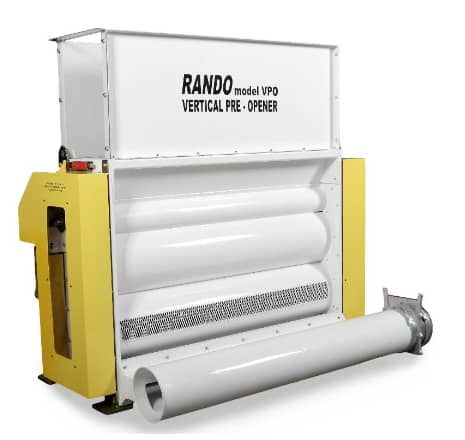
This new machine is designed to allow fiber to be fed vertically and pre-opened with a feed roll, main cylinder and brush roll. Rando rolls are wired vs. the competitors pinned rolls. Wired rolls are more cost effective to manufacture and require less servicing by the customer. Robustly built, the Vertical Pre-Opener is manufactured in standard widths from 36” to 100”. The vertical design creates a smaller footprint than earlier designed pre-openers that fed horizontally, thus running cleaner with gravity and constant vacuum pressure.

Conclusion

Airlay represents a powerful and sustainable method for producing versatile, high-performance nonwovens. With its flexibility in fiber sourcing, bonding, and structure, it is rapidly expanding across automotive, construction, and eco-friendly packaging sectors.

Frequently Asked Questions

What is the Airlay process used for?
Airlay is used to manufacture insulation, acoustic padding, filtration media, and sustainable packaging.
What materials can be used in Airlay nonwovens?
Natural fibers, synthetic scraps, reclaimed textiles, and recycled blends including vinyl fiber, polyester, nylon, stainless steel, rayon, and carbon.
Are Airlay fabrics environmentally friendly?
Yes, especially when made with recycled or natural materials and dry-laid processing.
What’s the difference between carded and Airlay webs?
Carded webs are fiber-aligned using mechanical rollers, while Airlay uses air currents for deposition.
How does Airlay improve thermal insulation performance?
Its lofted, layered structure traps air and resists heat transfer effectively.
What industries benefit most from Airlay nonwovens?
Automotive, construction, bedding, filtration, and sustainable packaging.
Is Airlay suitable for acoustic insulation?
Absolutely. Its porous, dense structure absorbs sound and reduces vibration.
Can Airlay materials be made from 100% recycled fibers?
Yes, depending on bonding technique and fiber quality.
What is the GSM range typically supported in Airlay fabrics?
Airlay fabrics can range widely from 15 GSM to over 5,000 GSM+, depending on the application.

Rando Airlaid Technology: High-Performance Nonwoven Solutions for Filtration, Hygiene & Insulation

Rando Airlaid® technology is an advanced nonwoven manufacturing process that delivers high-loft, isotropic, and uniform fiber webs ideal for demanding applications such as air filtration, medical wipes, thermal insulation, automotive acoustics, and hygiene products. Developed by Rando Machine Corporation, this airlay method ensures superior fiber distribution, performance consistency, and design flexibility.

Rando Machine
100 Rawson Road, Suite 230
Victor, New York 14564 USA
646.817.4218

www.randomachine.com

This new machine is designed to allow fiber to be fed vertically and pre-opened with a feedroll, main cylinder and brush roll. Rando rolls are wired vs. the competitors pinned rolls. Wired rolls are more cost effective to manufacture and require less servicing by the customer, keeping your line up and running! Robustly built, the Rando Vertical Pre-Opener is manufactured in standard widths from 36” to 100”. It is highly recommended for BICO, Natural, Metal and Ceramic fibers. Our engineers are dedicated to finding new ways to open high-cost fiber such as BICO. Ensuring all bundles, tufts and filaments are 99% opened saves on material costs and creates better bonding characteristics.
The vertical design creates a smaller footprint than earlier designed pre-openers that fed horizontally, thus running cleaner with gravity and constant vacuum pressure.
In trials The Rando Vertical Pre-Opener was used successfully with natural fibers for reducing breakage. Rando had great success in running fiberglass in stick form; pre-opening the sticks so downstream equipment can process the fiber with less fiber loss and better opening.
This new machine from Rando can be mounted to other feeding machines or can be pneumatically fed. The fibers are pre-opened and are removed with an air handling system to the next machine in use. It can also be used as a standalone machine.

Since 1949, Rando Machine has been the pioneer in air laid technology for the nonwoven textile industry. Headquartered in Victor, New York, Rando Machine added a second manufacturing location in Lafayette, Indiana after coming under new ownership in 2019. Rando offers a complete line of machinery from Fiber Preparation to Web Formation. As a global provider; Rando has no geographical limits and their machines can process both synthetic and natural fibers, as well as metallic and ceramic, all with outstanding track records!

For more information on the Rando Vertical Pre-Opener, or to see how Rando Machine can improve your production process, contact us today! [email protected]

Rando Machine
100 Rawson Road, Suite 230
Victor, New York 14564 USA
646.817.4218

www.randomachine.com

Since 1949 Rando® Machine has led the way providing innovative and high quality air laid machinery.  Rando offers world-class fiber preparation, web formation and recyclingmachinery that create high quality webs from the widest array of natural and synthetic fibers.Rando has significantly invested in new capabilities including a second manufacturing site since coming under new ownership in 2019.

WEB FORMATION

Rando’s web formation equipment is globally recognized for its ability to run challenging fibers into both low and high loft mats. 

FIBER PREPARATION

Rando compliments its state-of-the-art web formation machinery with a wide variety of fiber preparation equipment including:

  • Bale Breakers and Pre-feeders
  • Blend Line and Weigh Conveyors
  • Volumetric Reserves
  • Openers / Blenders

RECYCLING MACHINERY

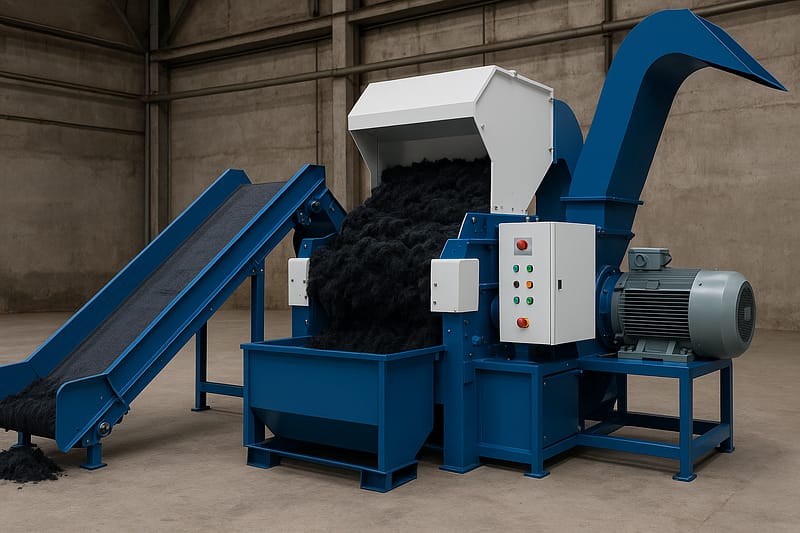
The Rando Shredder / Refiberizerreclaims excess finished material produced from a nonwoven line.The Shredder / Refiberizer includes state-of-the-art technology that breaks down edge trimmings into small, uniform tufts that are then reintroduced to production and blended to create a finished product.

PILOT LINE TESTING

Rando’s on-site Pilot Linetesting facility is available to customers for product and process development.  Working closely with you Rando will ensure you are using the exact fiber recipe for optimal web formation.  The pilot line is also available for small production runs. 

REPLACMENT PARTS / SERVICE

Maintain high performance with original replacement parts manufactured by Rando for every Rando machine, even vintage models. In addition, Rando offers fast turnaround torecloth/rewire wired rolls to the original factory specifications.

 Rando’s highly trained technicians provide service globally including:

  • On-site performance evaluations
  • Commissioning of new machines
  • Maintenance and Repairs
  • Machine upgrades and retrofits

Preventative Maintenance programs

RANDO’S LATEST INNOVATION – HIGH LOFT CONDENSER MAKING 10” INCH HIGH WEBS POSSIBLE!

Rando now offers three types of forming styles that all can be used on the main frame of their Webbers:

SB Condenser – heavier fibers, 100 denier and above

SD Condenser – finer fibers, nano up to 100 denier

SHL Condenser – the capability of the SD style with added high loft, up to 10” inches in height

The SHL Condenser allows you to form webs from 3/4″ inch to 10″ inches highby only changing the speeds on the HMI.  The SHL Condenser excels with a wide range of fibers including fiberglass, synthetic fibers, and natural fibers such as hemp, jute, wood, and cotton.

Bring your challenging application to Rando today and let us show you what we can do!


For more information visit us at www.randomachine.com or contact us at [email protected]

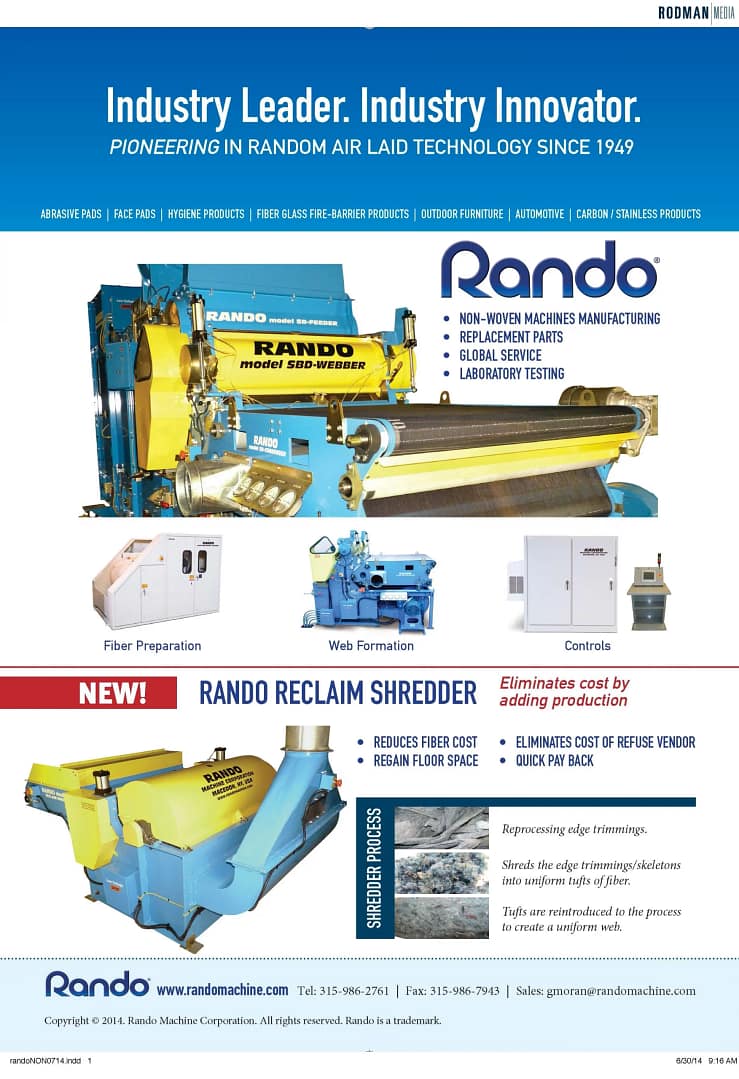
Introducing the latest in machine innovation from Rando Machine Corporation; the Rando Waste Shredder / Refiberizer.

  • Reduce fiber costs 
  • Regain floorspace
  • Eliminate cost of a reserve vendor
  • Quick payback

Rando© Machine, a pioneer leading the way into the future of air laid technology, who began designing and manufacturing air laid Feeders/Webbers and other supporting machinery in 1949. Today, Rando offers world-class innovative fiber preparation and web formation machines that process and create high quality webs from the widest array of natural and synthetic fibers.

FIBER PREPARATION AND WEB FORMATION MACHINES

Globally recognized, Rando compliments its state-of-the-art web formation by adding fiber preparation equipment such as:

  • Bale Breakers
  • Volumetric Reserves
  • Pre-feeders
  • Opener/Blenders

This offers a more effective approach to fiber applications.

LABORATORY TESTING

Rando’s on-site Laboratory Testing Facility allows customers to:

  • Experience Rando’s air laid environment.
  • Test, experiment and innovate with various fibers, fiber blends and processes to improve current products and create new offerings.
  • Out-source and contract Rando’s test lab as a long term resource.

REPLACMENT PARTS / SERVICE

Rando keeps you up and running at peak performance with its highly technical replacement parts and services team. 

Protect your performance with original replacement parts manufactured by Rando for every Rando machine, even vintage models. In addition, Rando offers reclothing/rewiring of wired rolls, using the original roll for your Rando rolls. 

Rando’s highly trained technicians provide service globally, offering:

  • On-site performance evaluations
  • Installation of new machines
  • Repairs
  • Machine upgrades and retrofits
  • On-site maintenance

REPLACMENT PARTS / SERVICE

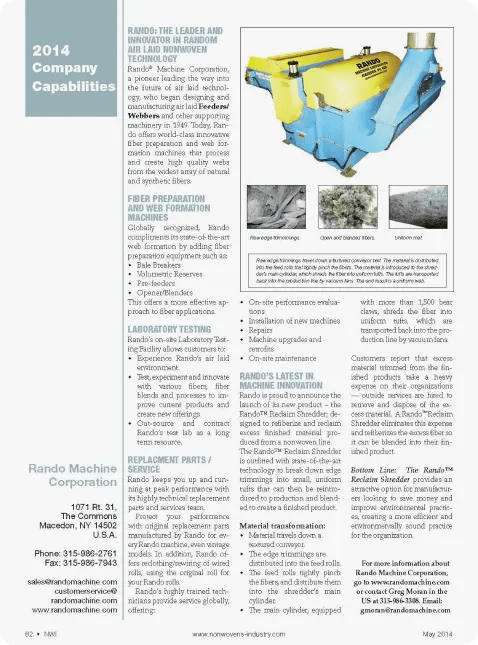
Rando is proud to announce the launch of its new product – the Rando™ Shredder Waste Reducer / Refiberizer; designed to refiberize and reclaim excess finished material produced from a nonwoven line.
The Rando™ Shredder Waste Reducer / Refiberizer is outfitted with state-of-the-art technology to break down edge trimmings into small, uniform tufts that can then be reintroduced to production and blended to create a finished product.

Material transformation:

  • Material travels down a textured conveyor.
  • The edge trimmings are distributed into the feed rolls.
  • The feed rolls tightly pinch the fibers, and distribute them into the shredder’s main cylinder.
  • The main cylinder, equipped with more than 1,500 bear claws, shreds the fiber into uniform tufts, which are transported back into the production line by vacuum fans.

Customers report that excess material trimmed from the finished products take a heavy expense on their organizations — outside services are hired to remove and dispose of the excess material. A Rando™ Shredder Waste Reducer / Refiberizer eliminates this expense and refiberizes the excess fiber so it can be blended into their finished product.

Bottom Line: The Rando™ Reclaim Shredder provides an attractive option for manufacturers looking to save money and improve environmental practices, creating a more efficient and environmentally sound practice for the organization.

Scroll to Top

Get A Quote