

As the cotton industry boomed across the American South, the industry had a problem it could not throw away. Its cotton mills and associated industries were producing waste fiber by the ton: short, tangled, uneven, and useless to the machinery of the day. In 1949, Rando was founded to solve exactly that. The idea was simple: take the fiber nobody wanted, and turn it into something with value.
To do it, Rando helped pioneer random air-laid nonwoven forming, a method of using custom technology to form fibrous webs. This was Rando’s solution to utilizing a sub-grade cotton fiber, a messy input with limited value. This origin story, dating back to 1949, has opened the lane the company has occupied ever since. Today, Rando’s capabilities far exceed just random airlaid technology. The company has since pioneered methods to handle the toughest fiber challenges. From fiber blending, opening, bonded panel recycling, and more, Rando has found a niche as both a global pioneer of nonwoven fiber manufacturing technologies, while also being the only company in the United States to manufacture nonwoven solutions to this day.
From a workshop idea to a machinery company
Following the invention of unique air-laid forming technology in the 50’s and 60’s from a small workshop, Rando has grown into a company with a global portfolio of installations. The following decades broadened Rando’s narrow expertise of waste cotton fiber into a company capable of producing full lines of machinery. In 1974, Rando was formally incorporated as Rando Machine Corporation in Macedon, NY. What began as a way to reclaim waste cotton grew into fiber preparation, web forming, and recycling equipment, sold to manufacturers who needed custom built solutions for their most difficult challenges.
The thesis of Rando has stayed true: Rando’s reputation was built on applications that were too demanding, too specialized, or too unusual for standard equipment. That is still where the company wins today in 2026.
Why the old advantage is still the advantage
Rando’s core forming technology uses pressure and vacuum together to lay the web of fibers. The result is an isotropic structure, meaning the fibers are oriented randomly and evenly in every direction, rather than pulled into a grain, as is seen with carding technology. This randomized uniformity resulting from this technology even resulted in the namesake of the business, Rando Machine. It shows up as measurable performance in insulation and filtration, and it is difficult for competitors to replicate. It is the reason Rando is recognized worldwide as the best choice for commercial floor scrubber pads, and for most applications that run on stainless steel fiber.
Stainless steel fiber is a good illustration of the whole philosophy of Rando Machines. It is stiff, heavy, and abrasive, the kind of material that defeats equipment built for polyester. Rando has won global contracts for stainless steel abrasive nonwoven pads, and today it is recognized as the global leader for abrasive nonwovens. The same is true for short and difficult to process fibers, like carbon and aramid. These challenging fibers are a natural fit for Rando Machines. Today, with global textile waste requiring innovative solutions to solve recycling challenges, recycled and regenerated shoddy fibers containing cotton, polyesters, lyocell, and more also find a natural fit in Rando’s nonwoven manufacturing portfolio.
What Rando is today
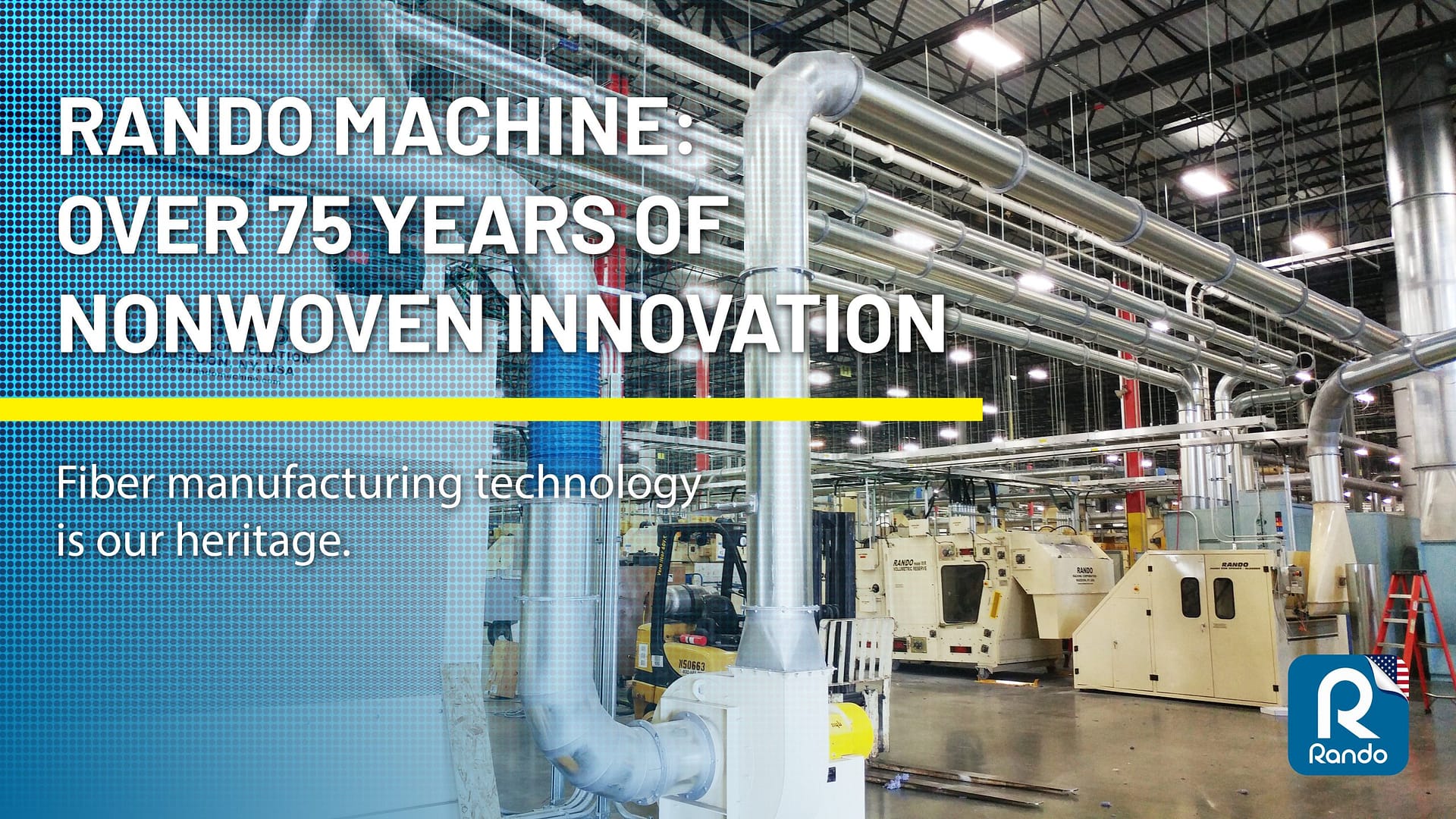
Three quarters of a century in, Rando designs and builds fiber preparation, web forming, and recycling equipment in New York, with machines running on six continents. The company found its next evolution in 2019, when Andy Wilcox, the owner of EIS and Inline Cleaning Solutions, acquired Rando Machine. With EIS and Inline Cleaning Solutions already possessing industrial machining technologies in its manufacturing center in Indiana, Rando has found ways to leverage production cost savings by extending its footprint beyond its New York State manufacturing hub. In a globally competitive environment for nonwoven OEM technology, Rando today is able to produce price competitive machines produced entirely in the United States.
Following the acquisition of Rando by Wilcox, substantial investments were made into Rando’s trial line. Wilcox, working with Rando’s brilliant engineering mind Bill Hardy, understood the importance of customers needing to build confidence in the technology through laboratory testing. From its workshop in Victor, New York, new and existing customers can prove out a process before they buy it. This trial line is one of the few places in North America to trial staple-fiber airlay at production scale. Rando’s trial line has processed cotton, textile shoddy, difficult natural fibers like hemp, flax, jute, and more. With an engineering-first mindset, Rando understands the importance of continued service and after-sales parts. Rando has a team of parts and field service technicians, able to work globally with their customers to ensure downtime is minimized and that production output is maximized.
Sustainability from day one
The nonwoven and textile industry talks about the importance of fiber recycling and utilization as if it were new. For Rando it is the founding purpose. The company was born reclaiming waste cotton, and it has been building recycling machinery ever since. Today that means fiberglass edge trim recovery, bonded panel reclamation, and the recycled and regenerated fibers that started it all. The sustainability story writes itself: it’s the how and why of Rando’s founding.
Seventy-five years is a long time to keep solving the same problem, but the technology and the solutions have not stayed the same. Rando Machines portfolio of technology today handles fibers that weren’t part of the conversation in 1949. While Rando’s competition focuses on cost reduction and winning the easy categories, Rando stays ahead by focusing on the demanding applications, the difficult fibers, and the jobs that call for a true engineering partner. Since 1949, that is what Rando has built.
Explore what Rando’s machinery can do with your fiber, or bring your material to the pilot line and see Rando’s capabilities for yourself.
Introduction
What Is Fiber Recycling?
Nonwoven fiber recycling is the process of taking waste or scrap materials and breaking them down into usable fiber that can be used to manufacture new products. Fibers can be recovered during the manufacturing process (before or after bonding), as well as recycling used materials such as textiles. Some examples include:
- reusing edge-trim in the manufacturing process
- Re-fiberizing skeletons or scrap bonded material to recover and reuse the fiber
- Shredding and re-fiberizing textile waste
- Blending recycled fibers into virgin material streams to manufacture new products
- Using chemical processes to break down textile waste into component fibers which can then be used to manufacture new products
- Using mechanical processes such as shredding and re-fiberizing to create fibers which can be blended with virgin fiber to create new products
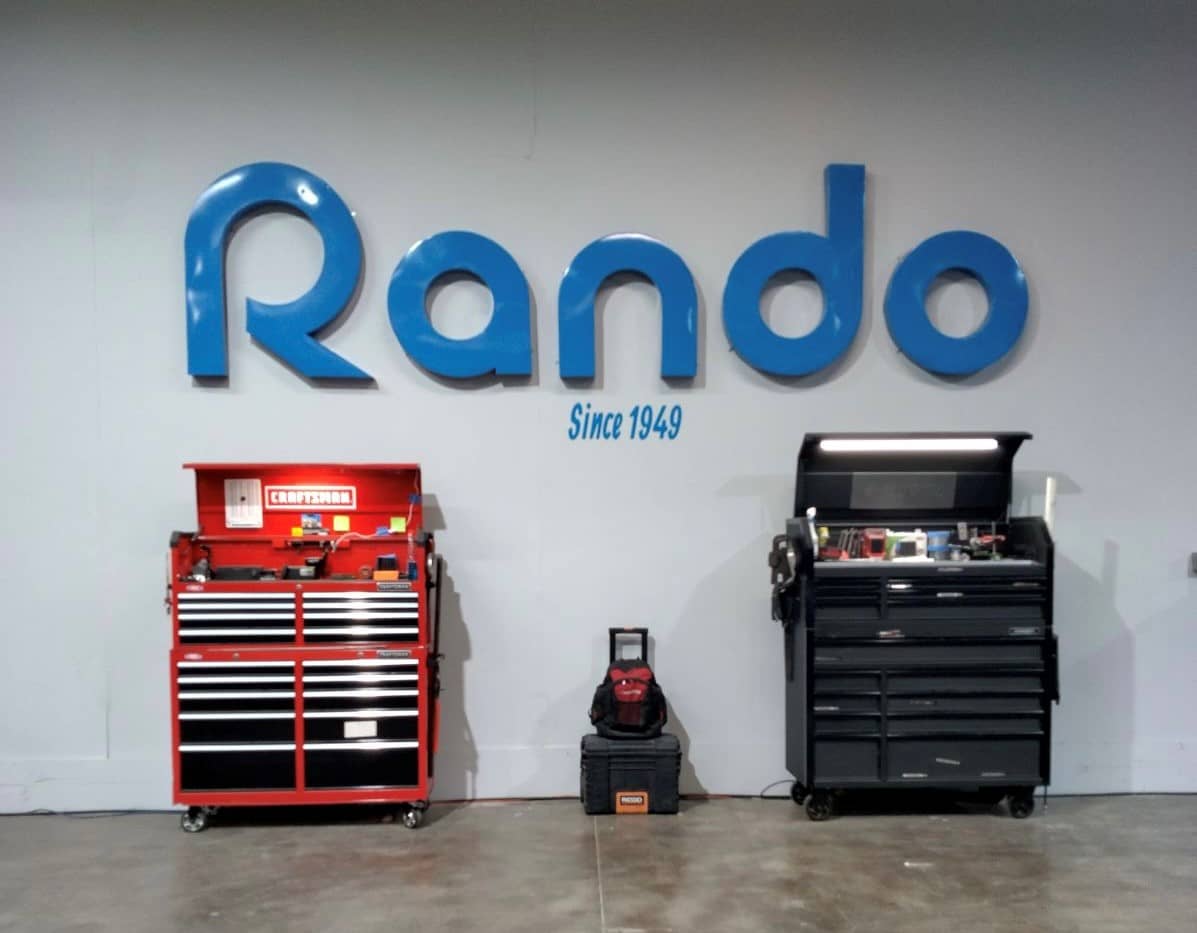
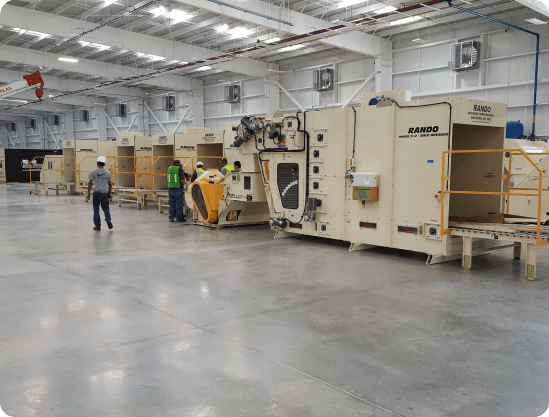
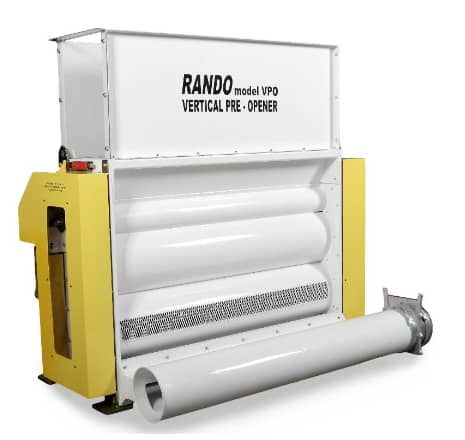
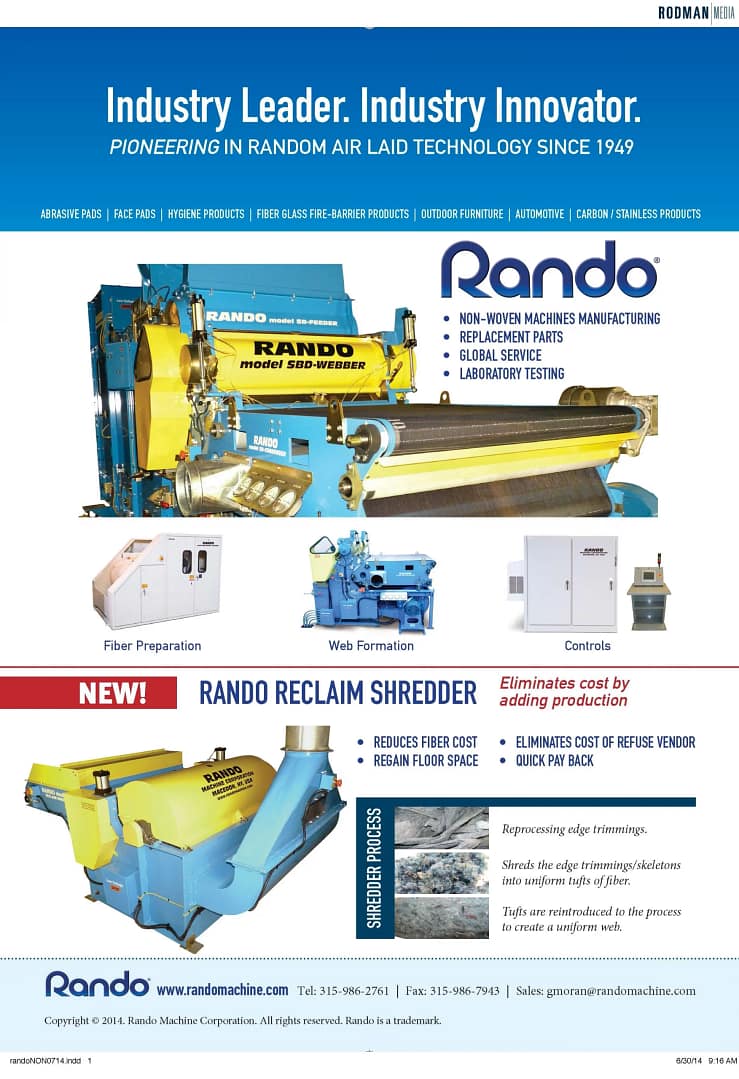
Rando© Machine, a pioneer leading the way into the future of air laid technology, who began designing and manufacturing air laid Feeders/Webbers and other supporting machinery in 1949. Today, Rando offers world-class innovative fiber preparation and web formation machines that process and create high quality webs from the widest array of natural and synthetic fibers.
FIBER PREPARATION AND WEB FORMATION MACHINES
Globally recognized, Rando compliments its state-of-the-art web formation by adding fiber preparation equipment such as:
- Bale Breakers
- Volumetric Reserves
- Pre-feeders
- Opener/Blenders
This offers a more effective approach to fiber applications.
LABORATORY TESTING
Rando’s on-site Laboratory Testing Facility allows customers to:
- Experience Rando’s air laid environment.
- Test, experiment and innovate with various fibers, fiber blends and processes to improve current products and create new offerings.
- Out-source and contract Rando’s test lab as a long term resource.
REPLACMENT PARTS / SERVICE
Rando keeps you up and running at peak performance with its highly technical replacement parts and services team.
Protect your performance with original replacement parts manufactured by Rando for every Rando machine, even vintage models. In addition, Rando offers reclothing/rewiring of wired rolls, using the original roll for your Rando rolls.
Rando’s highly trained technicians provide service globally, offering:
- On-site performance evaluations
- Installation of new machines
- Repairs
- Machine upgrades and retrofits
- On-site maintenance

REPLACMENT PARTS / SERVICE
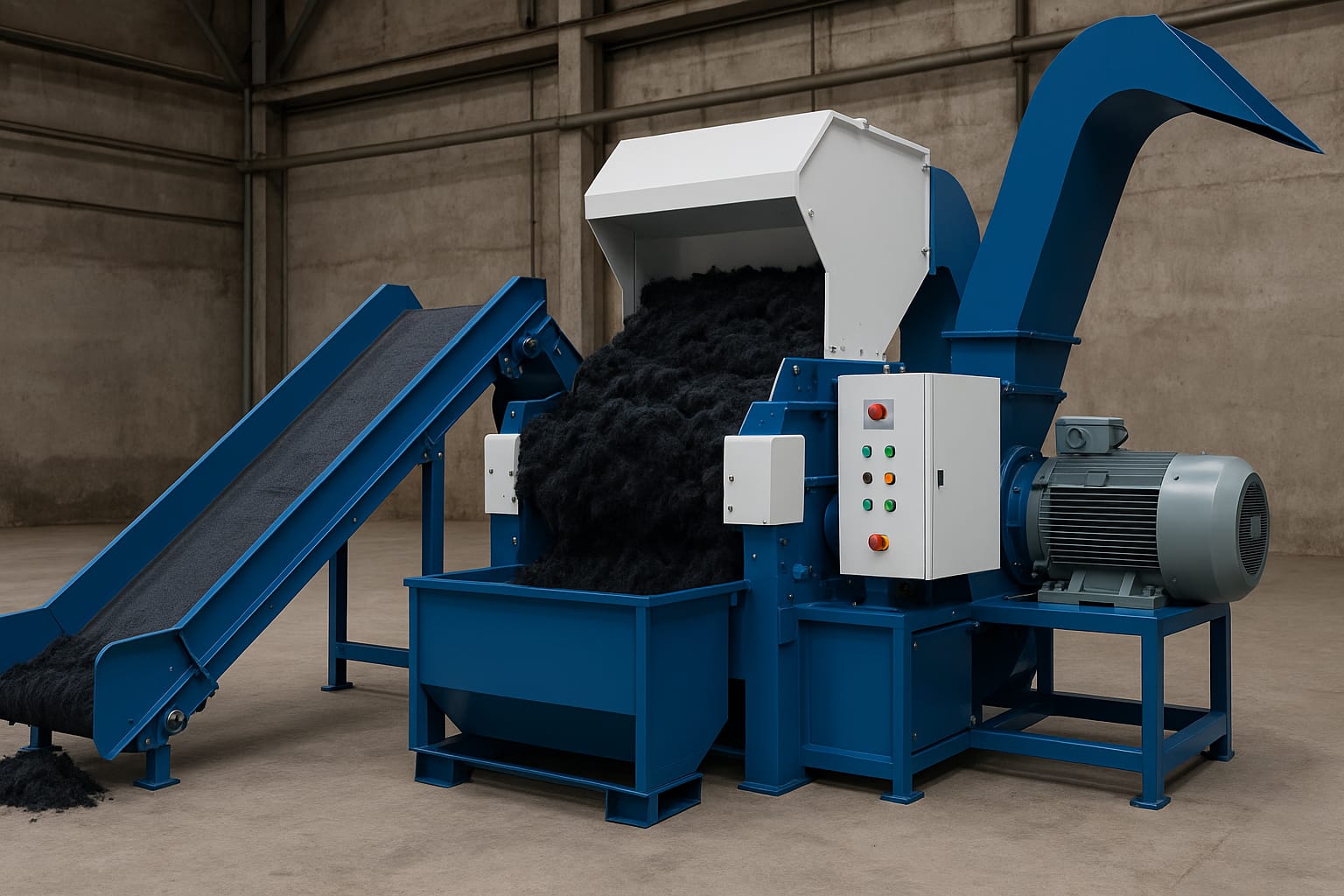
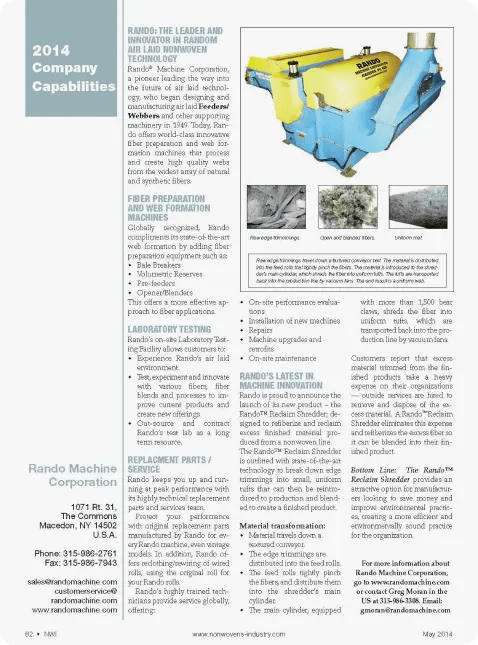
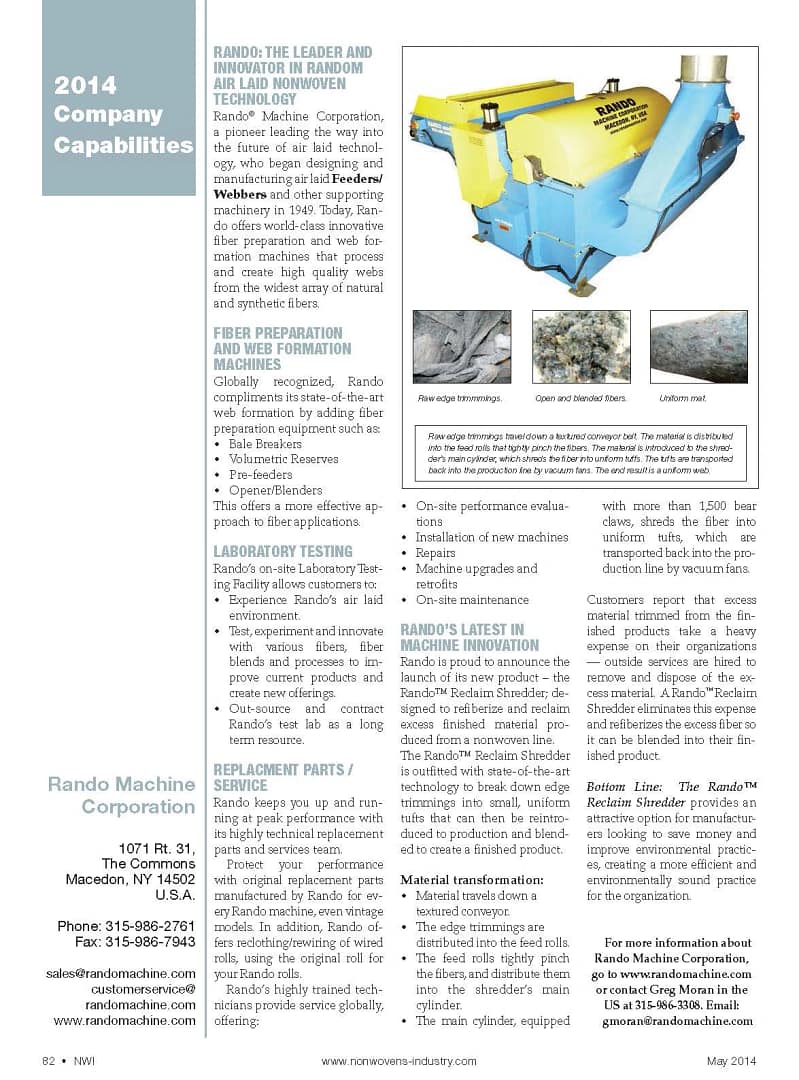
Rando is proud to announce the launch of its new product – the Rando™ Shredder Waste Reducer / Refiberizer; designed to refiberize and reclaim excess finished material produced from a nonwoven line.
The Rando™ Shredder Waste Reducer / Refiberizer is outfitted with state-of-the-art technology to break down edge trimmings into small, uniform tufts that can then be reintroduced to production and blended to create a finished product.
Material transformation:
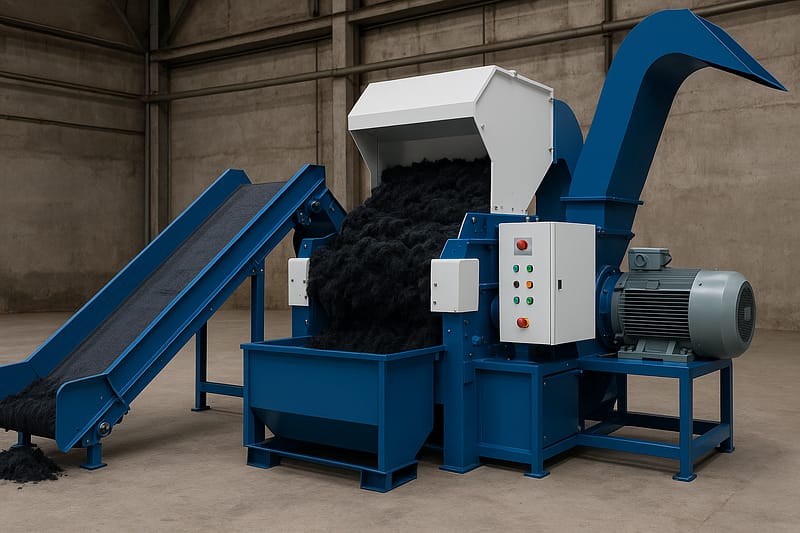
- Material travels down a textured conveyor.
- The edge trimmings are distributed into the feed rolls.
- The feed rolls tightly pinch the fibers, and distribute them into the shredder’s main cylinder.
- The main cylinder, equipped with more than 1,500 bear claws, shreds the fiber into uniform tufts, which are transported back into the production line by vacuum fans.
Customers report that excess material trimmed from the finished products take a heavy expense on their organizations — outside services are hired to remove and dispose of the excess material. A Rando™ Shredder Waste Reducer / Refiberizer eliminates this expense and refiberizes the excess fiber so it can be blended into their finished product.
Bottom Line: The Rando™ Reclaim Shredder provides an attractive option for manufacturers looking to save money and improve environmental practices, creating a more efficient and environmentally sound practice for the organization.