What Is Airlay? A Complete Guide to the Nonwoven Process
The Random Airlaid Process is a dry-laid nonwoven technology that uses airflow to randomly deposit individual fibers into a uniform web structure. Unlike carded or spunbond nonwovens, The Airlaid process achieves true isotropic orientation, which enhances strength, durability, and dimensional stability.
Introduction to Airlay Technology
Airlay, also known as the dry-laid process, is a nonwoven textile manufacturing method where loose fibers are dispersed in an airstream and deposited onto a forming belt to create a web. Unlike wet-laid or spunbond processes, Airlay does not require water or extrusion, making it ideal for blending natural and recycled fibers. This unique Airlay technology supports sustainable textile solutions and offers high versatility across multiple applications.
The Airlaid process while running at a slower production speed makes a stronger bond with the fibers than a carding machine. Carded fiber pad has a tendency to delaminate or come apart in layers while a random Airlaid fiber pad holds a more consistent and stronger pad and can achieve a higher loft.
How Airlay Nonwovens Are Made
Fiber Preparation
- Fibers are selected based on the desired properties (e.g. pulp, viscose, cotton, polyester).
- Commonly used: wood pulp, natural fibers, recycled fibers, and binder fibers (like bi-component fibers).
Fiber Opening
- Fibers are opened and separated into individual or small fiber clusters using deflakers or fiberizers.
- The goal is to create a loose, fluffy mix of fibers.
Fiber Air Suspension (Air laying)
- The opened fibers are entrained in a high-speed airstream.
- This air stream carries the fibers through a duct or chamber toward a forming screen or belt.
Web Formation
- The fibers are pulled out of the airstream onto a perforated conveyor belt or rotating drum using vacuum suction from below.
- This forms a loose, randomly oriented web on the surface.
- The thickness and density can be controlled by adjusting air speed, fiber feed, and vacuum pressure.
Web Bonding
After the web is formed, it must be bonded to gain strength. There are several bonding methods:
a) Thermal Bonding
- Uses bi-component fibers (e.g., fibers with a low-melting sheath) or thermoplastic binders.
- Web is passed through heated rollers or an oven, melting the binders to bond fibers.
b) Latex Bonding (Chemical)
- A liquid binder (latex) is sprayed or printed onto the web.
- Followed by drying to cure and bond the structure.
c) Hydrogen Bonding (for pulp-based Airlaid)
- Uses mechanical compression and moisture to form hydrogen bonds between cellulosic fibers.
- Typically used in toilet paper or napkins.
d) Needle Punching or Hydroentanglement (less common in pure Airlaid, sometimes hybridized)
Drying & Curing (if chemical bonding used)
- A drying oven removes moisture and cures any chemical binders applied.
Finishing
- The bonded web may go through processes like calendaring, cutting, molded, embossing, perforating, or lamination.
- Final products are rolled or sheeted for shipment.
Airlay excels in using reclaimed textile waste, cotton, wool, hemp, kenaf, Jote, and synthetic scraps, making it an eco-friendly fabric solution.
Key Properties of Airlay Materials
Loft and bulk
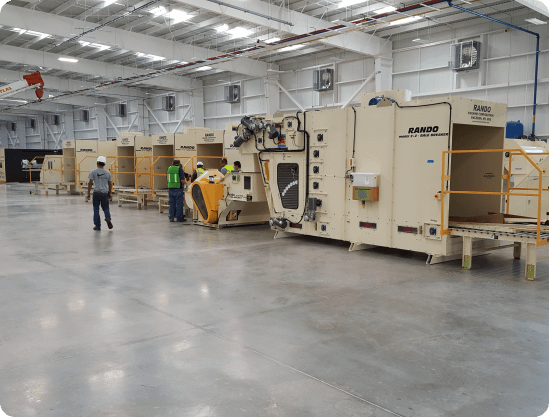
Rando equipment supports lofts up to 10” and width up to 124”
Insulation capabilities
Effective for both thermal insulation and acoustic performance.
High recovery and resilience
The structure springs back after compression.
Applications of Airlay Nonwovens
Automotive interiors (acoustic insulation, trunk liners)
Used in trunk liners, acoustic dampening panels, and seat padding.
Home insulation materials
Wall and roof insulation panels with strong thermal performance.
Filtration media
Airlaid material makes excellent filter media.
Bedding and mattress padding
Comfortable and breathable layers in mattresses.
Benefits of the Airlay Process
Allows incorporation of high-recycled content
Airlaid equipment allows you to use not only recycled content but by adding a refiberizer you can run your own scrap back through the equipment after it has been bonded.
Highly customizable GSM and thickness
You are able to get a more consistent product with tighter tolerances using an Airlaid machine instead of carding equipment.
Innovations in Airlay Technology
High Loft Condenser
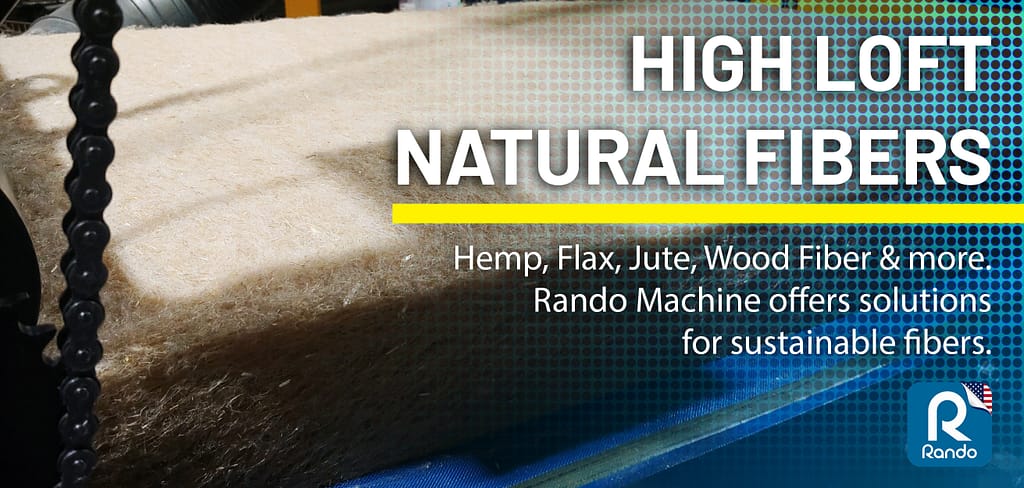
Versatility: make webs from ½” to 10” with no changeover, and runs a wide variety of natural and synthetic fibers
Web quality: The High Loft Condenser makes an isotropic web in a single pass, eliminating cards and cross lappers
Vertical Pre Opener
This new machine is designed to allow fiber to be fed vertically and pre-opened with a feed roll, main cylinder and brush roll. Rando rolls are wired vs. the competitors pinned rolls. Wired rolls are more cost effective to manufacture and require less servicing by the customer. Robustly built, the Vertical Pre-Opener is manufactured in standard widths from 36” to 100”. The vertical design creates a smaller footprint than earlier designed pre-openers that fed horizontally, thus running cleaner with gravity and constant vacuum pressure.
Conclusion
Airlay represents a powerful and sustainable method for producing versatile, high-performance nonwovens. With its flexibility in fiber sourcing, bonding, and structure, it is rapidly expanding across automotive, construction, and eco-friendly packaging sectors.
Frequently Asked Questions
What is the Airlay process used for?
What materials can be used in Airlay nonwovens?
Are Airlay fabrics environmentally friendly?
What’s the difference between carded and Airlay webs?
How does Airlay improve thermal insulation performance?
What industries benefit most from Airlay nonwovens?
Is Airlay suitable for acoustic insulation?
Can Airlay materials be made from 100% recycled fibers?
What is the GSM range typically supported in Airlay fabrics?
Rando Airlaid Technology: High-Performance Nonwoven Solutions for Filtration, Hygiene & Insulation
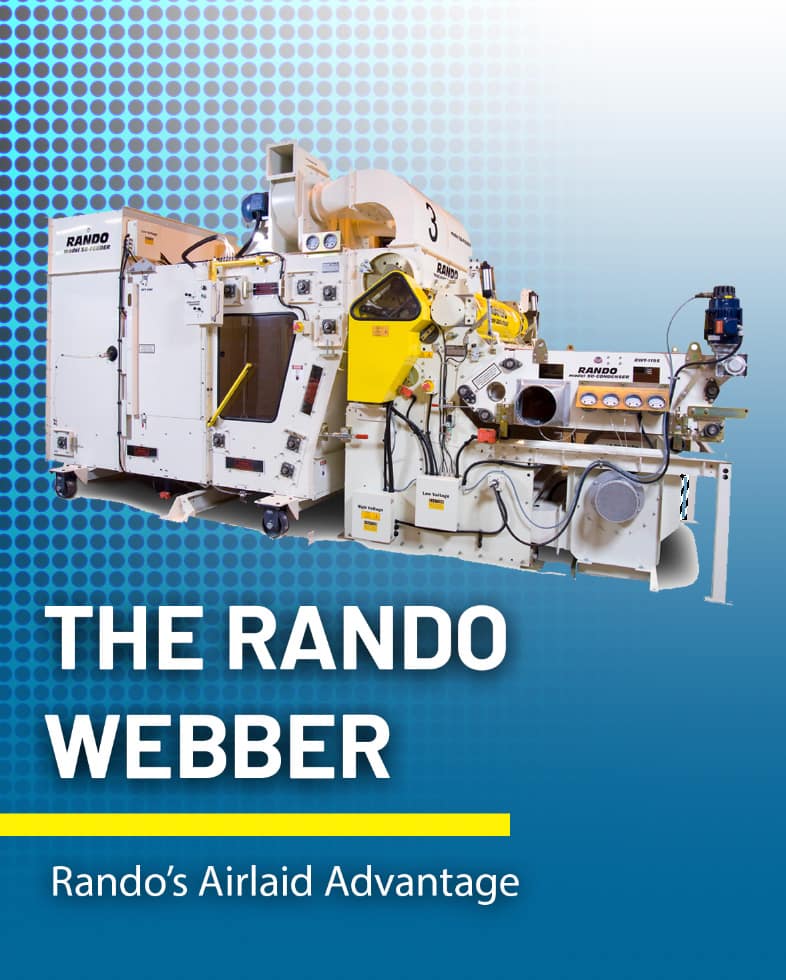
Rando Airlaid® technology is an advanced nonwoven manufacturing process that delivers high-loft, isotropic, and uniform fiber webs ideal for demanding applications such as air filtration, medical wipes, thermal insulation, automotive acoustics, and hygiene products. Developed by Rando Machine Corporation, this airlay method ensures superior fiber distribution, performance consistency, and design flexibility.
Rando Machine
100 Rawson Road, Suite 230
Victor, New York 14564 USA
646.817.4218
www.randomachine.com