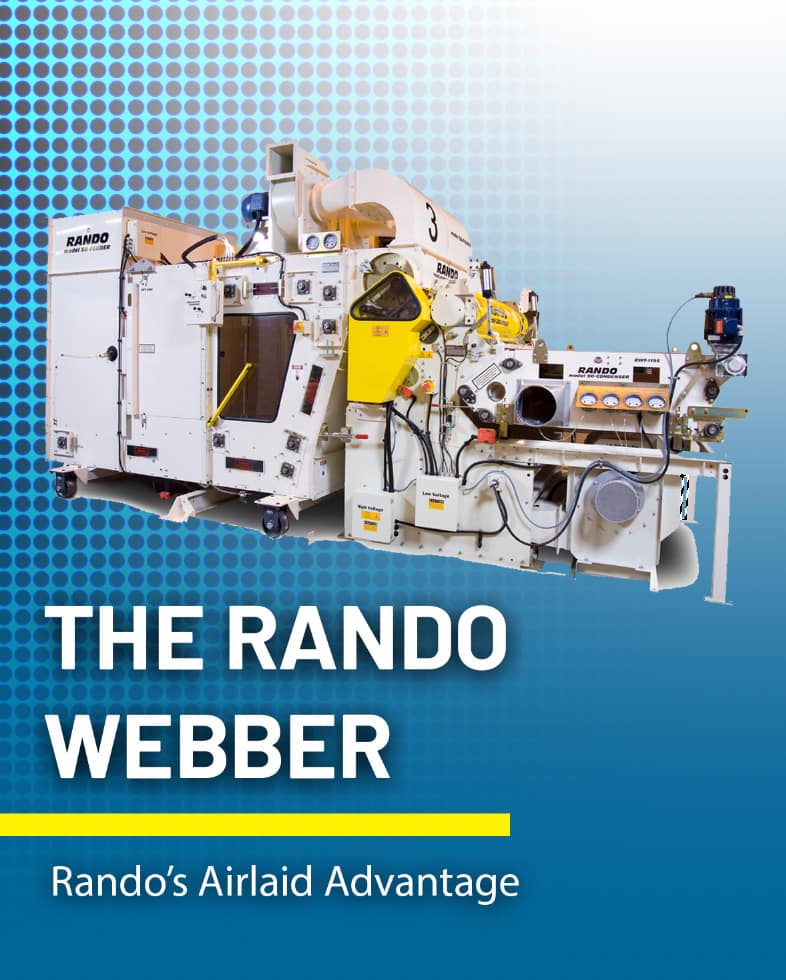
Every company has one machine that defines it. For Rando, it is the Webber. This machine is the airlaid web former that gave the company its name, and three quarters of a century later it is still the reason customers bring Rando their hardest fibers. The Webber does one thing exceptionally well: It lays loose fiber into a uniform web with true random orientation, and it does it with materials most equipment cannot touch.
Why random fiber orientation excels
There are many options for fiber web forming on the market. Many often look to carding machines for forming webs, and while carding certainly has its applications, it also has it’s limitations. Carding combs the fibers until they line up in the machine direction, which makes a web that is generally strong one way and weak the other. The Rando Webber does the opposite. It distributes fiber randomly and evenly in every direction, so the web has isotropic strength, meaning equal strength in all directions. That randomized uniformity the intention of the Rando Webber, and it is where the company got its name.
For a buyer, isotropic strength shows up as real performance: consistent weight, consistent loft, and uniform quality across the full width of the web. A web that behaves the same in every direction is easier to convert, more predictable in the field, and better suited to demanding applications from composites to filtration and everything in between.
One mechanism, built for control
The Webber forms the web with air, using a split air system that works the fiber with both pressure and vacuum, paired with AC variable-speed motors that give the operator fine control over how the fiber lands. That control is what produces the uniformity, and it is what lets a single platform run an unusually wide range of material and web geometry. Webs come off the machine anywhere from 12 to 110 inches wide, from thin veils to thick high-loft batts.
The Webber is also built on Rando’s wide options of configurations, it is not limited to a single configuration. It comes in three condenser styles, so the same platform can be tuned to the fiber and the web you actually need.
The SB condenser is built for heavier fibers, roughly 25 to 100 denier and above, forming at up to 66 feet per minute. The SD condenser handles the fine end, from nano fibers up to 100 denier, and runs fast, up to 150 feet per minute. The SHL condenser adds high loft to everything the SD can do, forming webs from three quarters of an inch to a full 10 inches tall.
What makes the SHL remarkable is the control. An operator moves loft across that entire range by adjusting speeds on the HMI, with no mechanical changeover. Many competitors lack the condenser optionality, and this optionality adds revenue generating potential for our customers. It runs fiberglass, synthetics, and natural fibers like hemp, jute, wood, and cotton with equal ease. That span, from a nano-denier veil to a 10-inch batt, is why one Webber platform can serve markets that would otherwise need several different machines.
The fibers other machines refuse
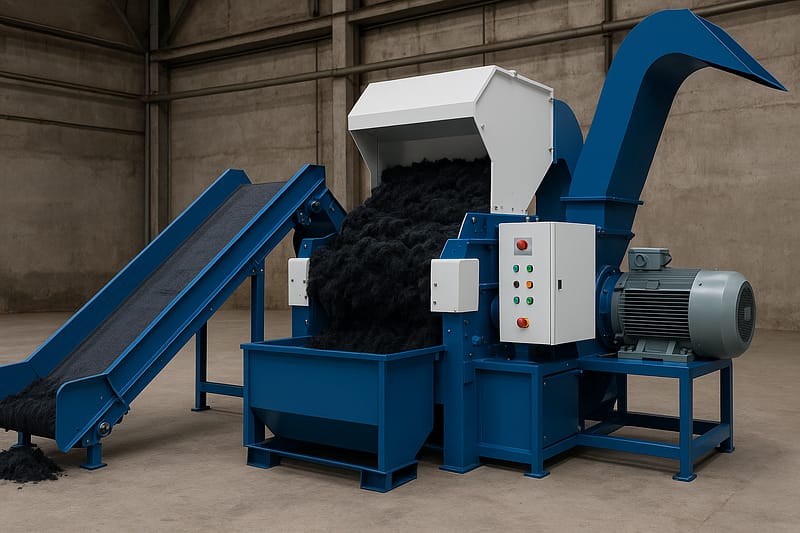
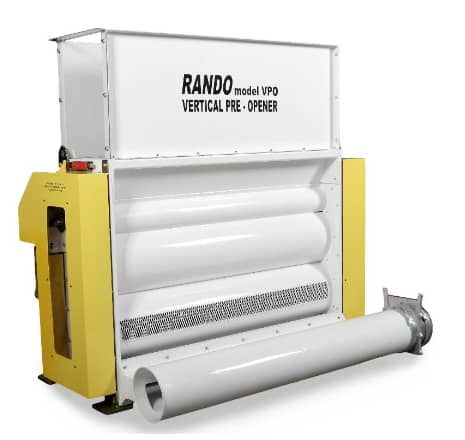
The Webber’s real signature is what it will run. Rigid and specialty technical fibers, glass, carbon, ceramic, and metallic fibers cause significant complications on equipment built for polyester. Thanks to Rando’s supporting fiber opening machinery, the Rando Webber can bring in low-melt fibers like polyester or polyethylene bicomponents, blends of dissimilar lengths and deniers, and recycled and regenerated waste.
Since 1949, Rando has taken pride in its ability to produce machinery that serves multiple industries. The same machine that runs stainless steel fiber for abrasive pads runs recycled shoddy for sustainable insulation, and even fiberglass edge trim reclaimed from a Rando’s bonded panel recycling machinery. With one forming platform, an enormous range of fibers are possible.
From the lab to the production floor
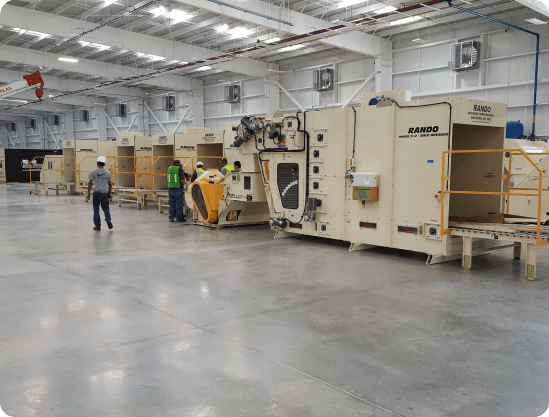
Rando builds its Rando Webber from pilot width up to wide commercial lines available in multi-meter width formats. With a visit to our trial facility in Victor, New York, a customer can prove a process on Rando’s pilot line and then buy the production version of the very machine they tested. The webs it forms end up in automotive components, filtration media, geotextiles, medical disposables, insulation, and more.
Since 1949, the Rando Webber has been our centerpiece machine for the fibers our competitors struggle with.
Book a trial on our Pilot Line today to see the Rando Webber in Action